
](https://www.sglpackaging.com/wp-content/uploads/2026/09/What-Is-the-Best-Packaging-for-Dried-Fruit.webp "What Is the Best Packaging for Dried Fruit? 1")
Dried fruit may look shelf-stable, but poor packaging can quickly change its texture, color, aroma, and flavor by allowing moisture or oxygen to enter.
The best packaging for dried fruit is usually a high-barrier, heat-sealed pouch with a resealable zipper. I often choose stand-up pouches for retail products, metallized or foil laminates for stronger moisture and oxygen protection, and clear high-barrier films when product visibility is important. Freeze-dried fruit normally needs especially strong moisture protection.
I do not select dried fruit packaging only by pouch shape. I first look at water activity, product stickiness, oil content, light sensitivity, expected shelf life, filling method, and distribution conditions. Raisins, dried mango, dates, banana chips, and freeze-dried strawberries can need very different packaging even though consumers place them in the same “dried fruit” category.
What Type of Packaging Is Best for Dried Fruit?
I usually start with a resealable flexible pouch because it combines barrier protection, low package weight, large printing areas, and convenient storage after opening.
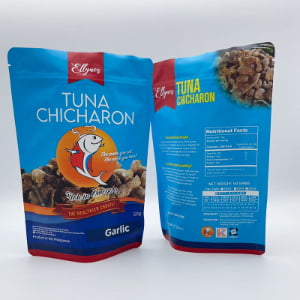
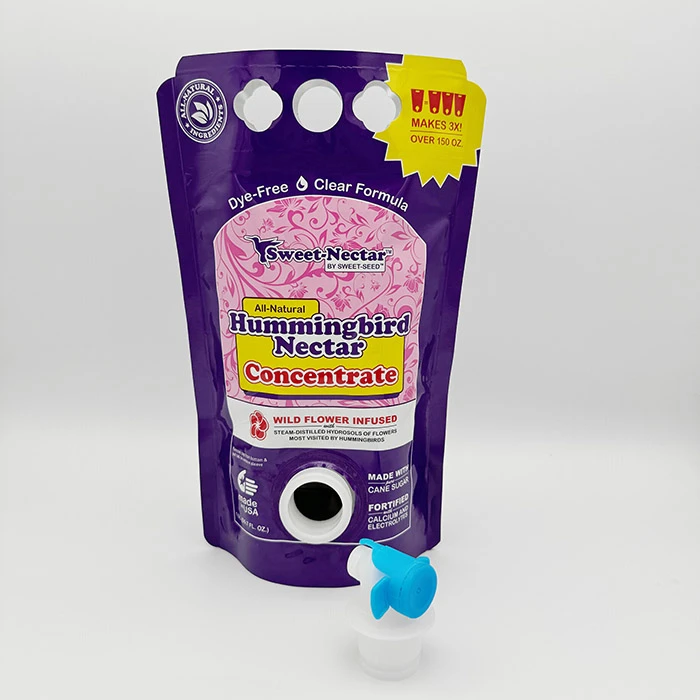
For most retail dried fruit, I prefer a stand-up pouch made from a suitable moisture- and oxygen-barrier laminate, finished with a reliable heat seal and zipper. Flat pouches work well for samples and smaller portions, while flat bottom bags can provide stronger shelf stability and a more premium presentation for higher-value products.
Stand-Up Pouches Work Well for Most Retail Products
A stand-up pouch has a bottom gusset that expands after filling.
I often consider it for:
- Dried mango
- Raisins
- Cranberries
- Dried apricots
- Dried pineapple
- Banana chips
- Dates
- Fruit-and-nut mixes
- Freeze-dried fruit
The standing base keeps the package visible on a retail shelf.
The front and back panels also give me enough room for product photography, flavor information, nutrition facts, ingredients, instructions, and branding.
A zipper is another major advantage.
Most consumers do not finish a 200 g or 500 g dried fruit package at one time. A zipper lets them close the pouch after opening.
I still place a permanent heat seal above the zipper for an unopened retail package.
The top heat seal provides the original package integrity. The zipper provides consumer convenience afterward.
Flat Pouches Can Be Better for Smaller Portions
A flat or 3-side seal pouch makes sense when I do not need the package to stand.
I may choose it for:
- Samples
- Single servings
- Subscription packs
- Airline portions
- Trial products
- Small freeze-dried fruit packs
The structure is simpler and usually uses less material than a standing pouch of similar dimensions.
If the product sits inside a display carton or ships mainly through e-commerce, standing ability may not add much value.
Flat Bottom Bags Can Support Premium Positioning
For premium dried fruit, I may also consider a flat bottom pouch.
Its rectangular base creates a more box-like shape.
That structure can provide:
- Strong shelf stability
- Larger internal volume
- Defined side panels
- Premium presentation
- More space for product information
The trade-off is usually greater converting complexity and higher cost.
My Basic Format Comparison
| Packaging Format | Best Use | Main Advantage |
|---|---|---|
| Stand-up pouch | Most retail dried fruit | Balance of protection, branding, and convenience |
| Flat pouch | Samples and small portions | Compact and economical |
| Flat bottom bag | Premium products | Excellent shelf stability |
| Side gusset bag | Larger quantities | Efficient volume |
| Rollstock/VFFS | High-volume production | Fast automated packing |
| Rigid jar or tub | Premium display or fragile products | Strong physical protection |
For me, the pouch format solves the merchandising and handling problem.
The film structure solves most of the shelf-life problem.
Why Does Dried Fruit Need High-Barrier Packaging?
The word “dried” can make the product sound easy to package. In reality, dried fruit can still exchange moisture with the surrounding air and undergo oxidation.
Dried fruit needs packaging that limits moisture transfer because moisture changes can make it sticky, soft, tough, or otherwise alter texture. Oxygen can also affect color, aroma, and flavor. I therefore select barrier performance according to the exact fruit, expected storage conditions, and required shelf life rather than using one film for every product.
Moisture Control Is Usually My First Priority
Dried foods can absorb moisture from surrounding air.
Utah State University Extension recommends storing dried foods in airtight containers or packages to prevent them from picking up moisture, which can contribute to quality loss and spoilage.
However, moisture behavior varies between products.
A chewy dried mango may have a different target texture from freeze-dried strawberries.
If a chewy dried fruit loses too much moisture, it can become hard.
If it gains too much moisture, it can become sticky or soft.
Freeze-dried fruit creates an even more demanding problem.
Its crisp, porous structure can pick up moisture very quickly. Once enough humidity enters the pouch, the product can lose its characteristic crunch.
For freeze-dried fruit, I therefore pay especially close attention to WVTR, or water vapor transmission rate.
Oxygen Can Affect Color and Flavor
Oxygen can also contribute to quality changes.
Amcor's technical discussion of nuts and dried fruits recommends choosing barrier performance based on each product's sensitivity to air, water, and light, as well as the desired shelf life. Dried fruit particularly needs protection against water vapor to help prevent unwanted texture changes.
When dried fruit is combined with nuts, I may need an even stronger oxygen barrier because nuts contain oils that can oxidize.
A dried cranberry-and-almond mix can therefore require different packaging from dried cranberries alone.
Seal Integrity Matters as Much as Film Barrier
I do not judge a pouch only from its published barrier specification.
A high-barrier film can still fail if the seal leaks.
Potential weak points include:
- Top seals
- Bottom gussets
- Zipper transitions
- Corners
- Side seals
- Areas contaminated by sugar or fruit particles
Current technical guidance for freeze-dried fruit packaging emphasizes that barrier-film selection and seal integrity are separate control points. A package with excellent film properties can still allow humidity or oxygen inside if the seal area is inconsistent.
I therefore evaluate the complete finished pouch, not only a film datasheet.
Is Foil or Metallized Film Better for Dried Fruit?
I usually choose between foil, metallized film, and transparent structures according to shelf-life demands and how important product visibility is to the brand.
Aluminum foil laminates offer very strong protection against moisture, oxygen, and light, while metallized films can provide a strong balance of barrier performance, cost, and flexibility. Clear PET/PE structures provide better product visibility but may offer less protection unless a transparent high-barrier coating is added. The right structure depends on the dried fruit.
Foil Laminates Provide Strong Protection
A traditional structure might be:
PET / AL / PE
In this construction:
- PET supports printing and mechanical strength.
- Aluminum foil provides strong barrier and light protection.
- PE provides the food-contact sealant layer.
I may consider foil for:
- Freeze-dried berries
- Premium dried fruits
- Long shelf-life products
- Export products
- Products stored in humid climates
- Light-sensitive fruit
The main disadvantage is material complexity.
Foil laminates combine different materials and are difficult to recycle through many conventional flexible-plastic recycling systems.
Metallized Film Can Provide a Practical Balance
Another common structure is:
PET / VMPET / PE
VMPET is metallized PET.
A very thin metallic layer improves barrier and blocks much of the light without using a full aluminum foil layer.
Current packaging guidance identifies PET/VMPET/PE as a common high-barrier direction for dried mango, berries, banana chips, fruit mixes, and other dried-food applications.
I often consider metallized structures when I need good commercial barrier performance but do not require the maximum protection of foil.
Transparent Pouches Can Sell the Product
Dried fruit is visually attractive.
Consumers often want to see:
- Color
- Piece size
- Texture
- Fruit quality
- Product consistency
A clear pouch or window can therefore help sell the product.
Simple PET/PE can provide good clarity and heat sealing for less demanding applications.
However, visibility creates a trade-off.
A transparent package does not block light in the same way as a metallized or foil structure.
For products that need both visibility and stronger barrier performance, transparent barrier films using coatings such as aluminum oxide can be considered.
My Material Comparison
| Material Direction | Main Strength | Main Trade-Off |
|---|---|---|
| PET/PE | Clarity and cost | Lower barrier than advanced laminates |
| PET/VMPET/PE | Strong moisture/light/oxygen protection | Product is mostly hidden |
| PET/AL/PE | Very strong barrier | Material complexity |
| PA/PE | Toughness and puncture resistance | Light barrier may be limited |
| Transparent barrier laminate | Visibility + improved barrier | Higher cost |
| High-barrier mono-PE | Recycling-oriented design | Must verify actual barrier performance |
I do not select one of these structures simply because it is popular.
I test it against the actual product and intended shelf life.
Should Dried Fruit Packaging Have a Zipper and Clear Window?
Both features can improve retail performance, but I only add them when they support the way consumers actually buy and use the product.
A zipper is valuable for most multi-serving dried fruit because it helps consumers reclose the pouch after opening. A clear window can increase product visibility and trust, but I use it carefully because transparent areas may reduce light protection. For sensitive or long-shelf-life products, a fully opaque high-barrier pouch may be the safer choice.
I Usually Recommend a Zipper for Multi-Serving Packs
Dried fruit is commonly eaten as a snack over several days.
A zipper makes sense for:
- 200 g packs
- 250 g packs
- 500 g packs
- Family-size bags
- Fruit-and-nut mixes
- Pantry packs
The zipper also makes stand-up pouches more practical for home storage.
However, I do not assume resealing returns the package to its original unopened barrier condition.
Each opening introduces new air.
The consumer may also leave small pieces of sugar-coated fruit in the zipper track.
This means package size still matters.
A smaller pouch that consumers finish quickly can sometimes protect the remaining product better than one oversized package that stays open for months.
Windows Help With Product Trust
Dried mango, strawberries, apricots, cranberries, and colorful fruit mixes can be visually persuasive.
A window lets consumers inspect the food before purchase.
I find this especially useful for products marketed around:
- Natural appearance
- Large fruit pieces
- No artificial colors
- Premium selection
- Handmade processing
However, the window should have a commercial purpose.
If the product is sensitive to light, I may reduce the window size or remove it completely.
I Think Window Placement Matters
A small vertical or shaped window can provide product visibility without exposing the entire contents.
I also avoid placing the window where product settling leaves it empty.
The design should be tested with actual filled pouches.
A beautiful digital mockup does not always represent how the fruit will settle during shipping.
Is Vacuum or Nitrogen Packaging Good for Dried Fruit?
Reducing oxygen inside the package can be useful for selected dried foods, but I do not use vacuum or nitrogen flushing automatically.
Vacuum packaging, oxygen absorbers, and nitrogen flushing can help reduce oxygen exposure for some dried fruit products. However, the best choice depends on fruit texture, fragility, oil content, shelf-life requirements, and packaging equipment. Vacuum can compress delicate fruit, while nitrogen can reduce oxygen without applying the same physical pressure.
Vacuum Packaging Can Reduce Air
Vacuum packaging removes much of the air before sealing.
Utah State University Extension notes that dried foods may be vacuum packed and that oxygen absorbers or nitrogen can also be used to reduce oxidation risks.
I might evaluate vacuum packaging for:
- Dense dried fruit
- Bulk packs
- Long-term storage
- Selected date products
- Food-service packages
However, vacuum pressure can change the appearance of fragile foods.
Freeze-dried strawberries, for example, can be crushed more easily than dense dates.
I would not use vacuum simply because lower oxygen sounds better.
Nitrogen Flushing Can Protect Fragile Products
Nitrogen flushing replaces some of the oxygen-containing air in the package with an inert gas.
This can help with oxygen-sensitive foods while keeping some cushioning inside the pouch.
I may consider it for:
- Freeze-dried fruit
- Fruit-and-nut mixes
- Premium snacks
- Products requiring longer shelf life
The pouch still needs a strong oxygen barrier.
If the film allows oxygen to enter quickly after sealing, the benefit of nitrogen flushing will gradually disappear.
This is why gas flushing and barrier packaging must be designed together.
Oxygen Absorbers Can Be Another Tool
An oxygen absorber may also help in selected applications.
I treat it as part of the total packaging system rather than a replacement for barrier film.
I also make sure the absorber is appropriate for the food and package size.
What Is the Best Sustainable Packaging for Dried Fruit?
I see growing interest in recyclable mono-material pouches, but I first check whether the structure can protect the dried fruit for the full intended shelf life.
High-barrier mono-material PE or PP pouches can be a strong sustainability-oriented option for some dried fruit products when their moisture, oxygen, sealing, and mechanical performance are sufficient. I evaluate recyclability together with shelf life because reducing packaging complexity has little value if inadequate protection creates more food waste.
Mono-PE Can Reduce Material Complexity
Traditional dried fruit laminates may combine:
- PET
- Metallized PET
- PE
- Aluminum foil
- Nylon
These structures can deliver excellent performance but may be difficult to recycle.
Mono-material designs aim to keep more of the package within one polymer family.
For example, some high-barrier PE structures use EVOH or specialized coatings while maintaining a PE-dominant design.
Current dried-fruit packaging suppliers list high-barrier PE/EVOH structures among recycling-oriented options for dry-food applications.
I still verify:
- OTR
- WVTR
- Heat-seal range
- Zipper compatibility
- Film stiffness
- Drop performance
- Local recycling rules
I do not describe a package as universally recyclable merely because it is mono-material.
Collection and recycling infrastructure vary by market.
Material Reduction Can Also Matter
I also look at package size.
Oversized pouches use more material and increase shipping volume.
For dried fruit, bag size should be based on volume, not weight alone.
Current dried-fruit packaging guidance notes that bulk density varies significantly, and freeze-dried fruit can require several times more package volume than conventional dried fruit of the same weight.
This is why I perform an actual fill test before approving final dimensions.
My Insights: What Is the Best Packaging for Dried Fruit
I think the best solution becomes clear when I treat dried fruit packaging as a moisture-management system first and a printed bag second.
The best packaging for dried fruit is a properly sized, high-barrier pouch with strong seals and a zipper for multi-serving products. I usually prefer stand-up pouches for retail use, metallized or foil laminates for demanding shelf-life conditions, transparent barrier structures when visibility matters, and especially low-moisture-transmission packaging for freeze-dried fruit.
I Think “Dried Fruit” Is Too Broad for One Packaging Specification
This is the most important point.
A raisin is not the same packaging problem as a freeze-dried strawberry.
A date is not the same as a banana chip.
A dried cranberry-and-nut mix creates different oxidation risks from plain dried apricots.
I therefore want to know:
- Product moisture or water activity
- Texture target
- Oil content
- Piece geometry
- Sugar coating
- Light sensitivity
- Shelf-life target
- Distribution temperature and humidity
Current technical guidance makes the same distinction: dried fruit packaging should be specified from water activity, stickiness, oxygen and light sensitivity, product geometry, and expected shelf life rather than assuming that all dried products need the same barrier.
I Think Freeze-Dried Fruit Should Be Treated Separately
Freeze-dried products are extremely light and porous.
They can also lose crispness quickly if moisture enters.
For these products, I usually prioritize WVTR before decorative features.
I would rather use a stronger opaque barrier pouch than a visually attractive clear package if the transparent option cannot preserve the desired texture.
I also pay close attention to seal integrity because a microscopic leak can undermine an excellent barrier film.
I Would Not Choose Barrier Specifications by Marketing Names
Terms such as:
- High barrier
- Foil pouch
- Premium barrier
- Moisture-proof
sound useful but can be too vague.
I prefer actual film structures and performance data.
When comparing OTR and WVTR, I also check the measurement conditions. Barrier values are measured at defined temperatures and humidity levels, so two numbers should not be compared blindly when their test conditions differ.
That makes my specification more reliable.
I Think Sealability Can Be More Important Than Adding Another Barrier Layer
A stronger film does not solve product contamination in the seal zone.
Sticky dried fruit and sugar particles can reach the top of the pouch during filling.
If those particles interfere with sealing, the package may develop leakage paths.
I therefore consider:
- Sealant layer
- Seal temperature
- Seal pressure
- Dwell time
- Filling accuracy
- Headspace
- Zipper position
- Seal cleanliness
This is especially important for high-speed packaging.
My Practical Dried Fruit Packaging Framework
| If I Am Packaging... | My First Choice |
|---|---|
| Retail dried mango | Stand-up zipper pouch |
| Raisins | High-barrier stand-up or flat pouch |
| Dates | Strong pouch with good seal/puncture resistance |
| Dried apricots | Moisture-barrier zipper pouch |
| Dried cranberries | Stand-up pouch |
| Banana chips | Strong moisture-barrier pouch |
| Freeze-dried berries | Very high moisture-barrier pouch |
| Fruit-and-nut mix | High oxygen + moisture barrier |
| Product sample | 3-side seal pouch |
| Premium dried fruit | Flat bottom or premium stand-up pouch |
| Bulk dried fruit | Large gusseted/high-strength bag |
| Visibility-focused product | Clear high-barrier pouch or window |
| Long export shelf life | Metallized or foil laminate |
| Recycling-oriented line | Qualified high-barrier mono-material pouch |
For me, the question “What is the best packaging for dried fruit?” does not have one universal material answer.
For many normal retail products, I would begin with a high-barrier stand-up zipper pouch.
For premium freeze-dried fruit, I would increase the moisture barrier and consider an opaque metallized or foil structure.
For colorful dried mango or apricots sold quickly through retail, I might use a transparent high-barrier film or a carefully designed window.
For fruit-and-nut mixes, I would pay more attention to oxygen because the oils in the nuts increase oxidation risk. Amcor also notes that mixed nuts and dried fruit can make barrier selection more complex because the components have different packaging needs.
The best package is therefore the one that keeps the actual dried fruit at its intended texture, color, aroma, and flavor until the consumer finishes it.
Conclusion
I usually choose a high-barrier resealable pouch for dried fruit, with stronger moisture protection for freeze-dried products and metallized or foil structures when longer shelf life demands greater protection.