
](https://www.sglpackaging.com/wp-content/uploads/2026/09/Essential-Insights-on-Fresh-Jujube-Packaging-Bags-for-Optimal-Preservation.webp "Essential Insights on Fresh Jujube Packaging Bags for Optimal Preservation 1")
Fresh jujube looks durable, but its thin skin, active respiration, and rapid water loss can cause shriveling, softening, browning, decay, and off-flavors after harvest.
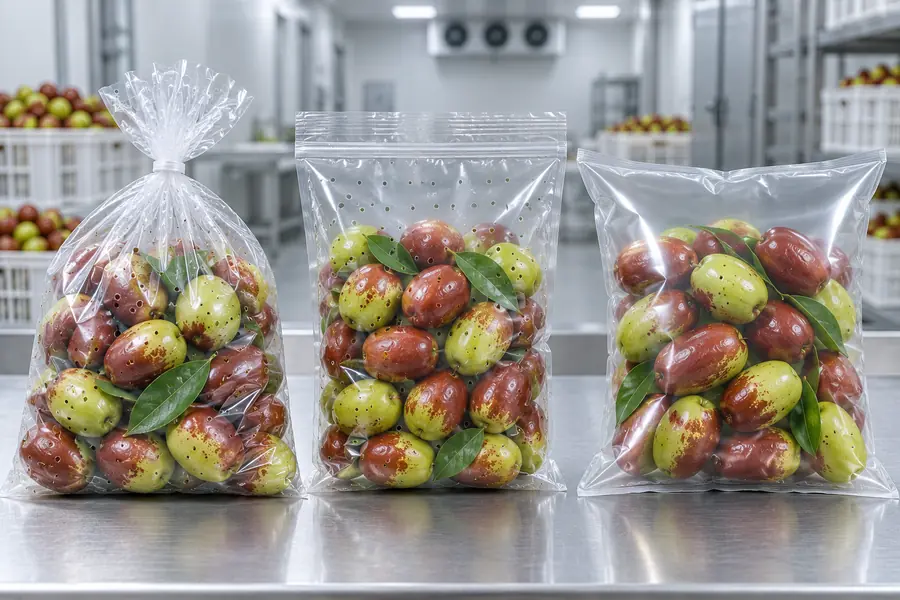
The best fresh jujube packaging bags balance moisture retention with controlled gas exchange. I usually consider micro-perforated PE, PP, or modified-atmosphere packaging rather than a completely airtight bag. The package should reduce dehydration without allowing excessive carbon dioxide, condensation, or oxygen depletion that can cause fermentation and quality loss.
I treat fresh jujube differently from dried jujube. Fresh fruit remains biologically active after harvest. It continues breathing, losing water, and changing internally. For that reason, film permeability, perforation, fruit maturity, storage temperature, humidity, pack weight, and cold-chain stability all influence how well a packaging bag performs.
What Type of Packaging Bag Is Best for Fresh Jujube?
A completely sealed high-barrier pouch may sound protective, but fresh jujube still needs oxygen. If gas exchange becomes too restricted, the package can create conditions that damage the fruit.
I usually prefer a carefully designed micro-perforated packaging bag or modified-atmosphere package for fresh jujube. The film reduces moisture loss while controlled perforations allow oxygen to enter and excess carbon dioxide to escape. This balance can slow respiration and shriveling without creating the anaerobic conditions associated with fermentation and off-flavors.
I Start With the Respiration of the Fruit
Fresh jujube is not like a bag of dried fruit.
After harvest, the fruit continues to respire. It consumes oxygen and releases carbon dioxide. Its respiration rate also changes with temperature, maturity, cultivar, and storage time.
If I place actively respiring fruit inside a package with very little gas permeability, oxygen levels can fall while carbon dioxide accumulates.
That sounds useful up to a point because lower oxygen can slow metabolism.
However, the atmosphere can go too far.
Research on winter jujube found that conventional non-perforated MAP can accumulate excessive carbon dioxide because of the fruit's high respiration rate. Precise micro-perforated MAP performed better because it allowed excess CO₂ to leave while providing additional O₂. This helped reduce anaerobic stress, alcoholic fermentation, and undesirable odors.
I Usually Compare These Packaging Directions
| Packaging Type | Main Advantage | Main Risk |
|---|---|---|
| Open produce bag | Strong ventilation | High moisture loss |
| Macro-perforated bag | Good airflow | May not control dehydration enough |
| Non-perforated PE bag | Strong moisture retention | CO₂ buildup and oxygen depletion |
| Micro-perforated PE/PP bag | Better gas/moisture balance | Perforation must match respiration |
| MAP bag | Can slow respiration and water loss | Wrong permeability can create off-flavors |
| Tray + micro-perforated film | Good retail presentation and fruit protection | More packaging components |
For retail and cold-chain use, I usually find micro-perforated MAP the most technically interesting starting point.
However, I do not copy one hole size or hole count from another product.
The correct micro-perforation depends on package size, film area, fruit weight, temperature, fruit maturity, and respiration rate. Research on winter jujube specifically used calculated perforation requirements rather than assuming that one perforation pattern would suit every condition.
Why Does Fresh Jujube Need Moisture-Control Packaging?
Shriveling is one of the most visible reasons fresh jujube loses commercial value. A fruit can remain edible yet look old and unattractive after losing too much water.
Fresh jujube packaging needs to reduce water loss because dehydration causes weight loss, lower firmness, leathery texture, and visible wrinkling. However, I avoid creating excessive internal humidity. A good bag limits transpiration while still allowing enough ventilation to reduce condensation and microbial risks.
The Skin Does Not Stop Water Loss Completely
Fresh jujube has a relatively thin epidermis and a high surface-to-volume ratio.
That makes water loss important after harvest.
As moisture leaves the fruit, internal cell pressure falls. The fruit can become softer, less firm, leathery, and wrinkled. A recent review identifies excessive water loss as a major cause of reduced marketability in fresh jujube.
This is why an unpackaged jujube can deteriorate quickly in dry air.
A plastic packaging bag changes the environment immediately.
It slows direct water transfer from fruit to surrounding air and increases humidity around the fruit.
That is helpful, but only until the package becomes excessively wet.
Too Much Humidity Creates a Different Problem
If condensation builds inside the bag, free moisture can collect on:
- Fruit surfaces
- Seams
- Corners
- Film surfaces
High humidity and condensation can create more favorable conditions for microbial growth.
A recent jujube postharvest review therefore describes packaging as a balance between moisture retention and ventilation rather than simply maximizing humidity.
I think this is one of the most important ideas when selecting fresh jujube packaging.
Maximum barrier is not automatically maximum preservation.
For dried jujube, I usually want a very strong moisture barrier.
For fresh jujube, I want a controlled environment.
Film Permeability Becomes Part of the Design
PE and PP films are common starting materials because they can provide:
- Moisture retention
- Good clarity
- Heat sealing
- Mechanical protection
- Relatively low package weight
- Compatibility with perforation
The film thickness also matters.
A thicker film may change gas and moisture transmission. A different resin can change permeability as well.
This means I do not specify fresh jujube packaging as simply “PE bag.”
I prefer a more complete specification covering:
- Film type
- Thickness
- Bag dimensions
- Fruit fill weight
- Perforation design
- Storage temperature
- Desired gas balance
That creates a much more useful packaging system.
How Does Modified Atmosphere Packaging Preserve Fresh Jujube?
MAP is useful because it changes the atmosphere immediately surrounding the fruit instead of trying to stop respiration completely.
Modified atmosphere packaging can slow fresh jujube respiration, moisture loss, softening, color change, and nutritional decline by creating lower oxygen and moderately higher carbon dioxide around the fruit. Micro-perforated MAP is especially useful because it can maintain gas exchange and reduce the risk of excessive CO₂ accumulation and anaerobic fermentation.
Passive MAP Uses the Fruit's Own Respiration
With passive MAP, I do not necessarily flush a special gas mixture into the package.
The fruit itself changes the package atmosphere.
It consumes O₂.
It releases CO₂.
The packaging film controls how quickly new oxygen enters and carbon dioxide exits.
Eventually, the system may approach an equilibrium.
The challenge is making sure that equilibrium falls within a useful range.
A recent review describes jujube MAP environments generally in the range of roughly 3–10% oxygen with carbon dioxide kept below about 5%, although the best atmosphere depends on the cultivar and storage conditions.
I treat these as research guidance rather than a universal commercial specification.
Precise Perforation Can Improve Gas Control
A 2024 winter jujube study gives a useful example.
Researchers designed precise laser micro-perforations for packages stored at both 2°C and 20°C. Their target steady-state atmosphere for that experimental system was about 5% O₂ and 1–2% CO₂.
The micro-perforated system reduced respiration and delayed reddening and decay. It also helped maintain flavor and antioxidant capacity while suppressing alcoholic fermentation and off-flavors.
That tells me something important.
I do not only need “some holes.”
I need the right gas-transfer capacity.
Large holes may allow too much exchange and lose the benefits of MAP.
No holes may allow too much CO₂ accumulation.
Micro-perforations give packaging engineers another way to tune the system.
Maturity Changes the Result
A 2025 study also showed that maturity stage affects MAP performance.
Jujube harvested at different maturity stages was stored at 0 ± 0.5°C and 90 ± 5% relative humidity for 42 days. MAP reduced weight loss and slowed respiration and firmness loss, while also helping preserve vitamin C and other quality indicators. Early- and mid-maturity fruit showed particularly useful preservation results under MAP.
This means the packaging supplier cannot solve every preservation problem alone.
Harvest maturity matters too.
I would therefore test commercial packaging using fruit harvested at the actual maturity stage the supply chain plans to sell.
How Important Is Cold Storage for Fresh Jujube Packaging?
A good packaging bag cannot compensate for an unstable cold chain. Temperature affects respiration so strongly that the same bag may behave very differently in cold storage and at room temperature.
Cold storage and packaging should be designed as one preservation system. Lower temperature slows jujube respiration, water loss, enzyme activity, and microbial development. It also changes the gas-exchange requirement of MAP bags. A micro-perforation pattern designed for refrigerated fruit may not create the same atmosphere if packages spend long periods at warmer temperatures.
Temperature Changes Respiration
As temperature rises, fruit metabolism generally becomes more active.
The jujube consumes oxygen faster and produces carbon dioxide faster.
This creates an important packaging problem.
Suppose I design a low-permeability bag that works very well at 2°C.
If the same package sits at 20°C for a long period, the fruit may breathe much faster than the bag can exchange gases.
Oxygen can fall.
Carbon dioxide can rise.
The same package can shift from useful MAP to harmful anaerobic conditions.
The 2024 micro-perforated MAP study specifically developed different perforation requirements for 2°C and 20°C conditions. That shows why temperature needs to be part of the packaging specification.
Refrigeration Slows Multiple Quality Changes
A broad review of jujube preservation reports that cold storage can reduce:
- Respiration
- Ethylene-related activity
- Enzymatic changes
- Softening
- Microbial development
The review highlights approximately 0–1°C and high relative humidity as effective conditions in several jujube studies, although suitable commercial temperatures can vary with cultivar, maturity, and chilling sensitivity.
I therefore avoid presenting one temperature as correct for every jujube supply chain.
I Design for the Weakest Part of the Cold Chain
Commercial fruit rarely stays at one perfect temperature from packing house to consumer.
It may move through:
- Precooling.
- Cold storage.
- Refrigerated transport.
- Distribution center.
- Retail display.
- Consumer transport.
Temperature abuse at any stage can increase respiration rapidly.
For MAP packaging, that can also change internal gas composition.
This is why I would conduct filled-pack trials that simulate realistic temperature changes instead of testing only at one constant laboratory temperature.
A practical jujube packaging project should evaluate:
- Internal O₂
- Internal CO₂
- Weight loss
- Condensation
- Firmness
- Browning
- Decay
- Odor
- Taste
Packaging success is not only an intact bag.
It is acceptable fruit quality at the end of distribution.
Should Fresh Jujube Bags Be Perforated or Completely Sealed?
This is one of the most important practical decisions because fresh jujube needs both moisture retention and respiration control.
I usually prefer controlled micro-perforation over a fully airtight fresh jujube bag when fruit respiration is high. A fully sealed package can retain water very well, but it may also accumulate CO₂ and deplete O₂. Proper micro-perforation gives the package a controlled route for gas exchange while still reducing dehydration.
Non-Perforated Film Can Retain Moisture Very Well
This can initially look like excellent packaging.
The fruit loses less weight.
The skin may remain smooth.
The bag retains high humidity.
However, internal gas composition keeps changing as the fruit breathes.
If gas permeability is too low, the package can become stressful for the fruit.
Traditional non-perforated MAP has been specifically identified as a problem for high-respiration winter jujube because excessive carbon dioxide can accumulate.
Macro-Perforation Can Go Too Far in the Other Direction
Large holes exchange gases easily.
However, they also allow more water vapor to escape.
The package then starts behaving more like ordinary ventilated produce packaging.
This may reduce gas-related problems but provide less control over water loss.
Micro-Perforation Gives Me a Middle Ground
Precise micro-perforation can control the total open area much more carefully.
Modern laser systems can produce very small holes with consistent dimensions.
In the 2024 jujube study, researchers designed perforation according to predicted package gas composition rather than simply testing random holes.
I think this is the direction commercial fresh-produce packaging increasingly needs.
Instead of asking:
“Should the bag have holes?”
I ask:
“What oxygen and carbon dioxide transfer does this fruit need under this temperature and fill weight?”
That turns perforation from a generic feature into an engineered preservation tool.
What Features Should I Consider When Designing Fresh Jujube Packaging Bags?
I think package design should begin with fruit physiology and logistics, then move to printing, branding, and retail appearance.
A fresh jujube packaging bag should be sized for the actual fill weight, provide controlled gas exchange, reduce moisture loss, resist puncture, seal consistently, and work at the intended storage temperature. I also consider transparency, anti-fog performance, condensation, pack ventilation, mechanical protection, food-contact suitability, and compatibility with trays or cartons.
I Start With Pack Weight and Headspace
A 250 g retail package does not breathe at the same total rate as a 2 kg package.
More fruit means more total oxygen consumption and carbon dioxide generation.
Bag volume also changes headspace.
This means I do not simply enlarge the same bag and keep the same perforation pattern.
I redesign gas transfer around the new system.
Transparency Can Support Retail Sales
Fresh jujube is visually attractive.
Consumers often judge:
- Color
- Firmness
- Surface shine
- Uniformity
- Fruit size
- Visible defects
Clear packaging can therefore support product confidence.
However, condensation can quickly reduce visibility.
An anti-fog film or coating may improve retail presentation when high internal humidity is expected.
Mechanical Protection Still Matters
Fresh jujubes can develop damage from compression, rubbing, or impacts.
A flexible bag provides limited structural protection by itself.
For fragile premium fruit, I may combine a bag or lidding film with:
- PP tray
- PET tray
- Pulp tray
- Corrugated carton
- Divider system
A recent jujube review notes that packaging container type can influence both moisture loss and physical protection.
My Practical Fresh Jujube Packaging Checklist
| Design Factor | What I Check |
|---|---|
| Film material | PE, PP, or suitable produce film |
| Gas exchange | Permeability + micro-perforation |
| Moisture control | Enough retention without excessive condensation |
| Fruit weight | Total respiration load |
| Headspace | Available package atmosphere |
| Storage temperature | Affects respiration and gas balance |
| Fruit maturity | Changes storage behavior |
| Puncture resistance | Prevents package failure |
| Transparency | Supports retail inspection |
| Anti-fog | Improves visibility |
| Seal quality | Prevents unintended leaks |
| Secondary pack | Prevents crushing during transport |
I treat this checklist as a system.
Changing one factor can change another.
My Insights: Essential Insights on Fresh Jujube Packaging Bags for Optimal Preservation
I think the key insight is that successful fresh jujube packaging depends less on finding the “strongest” barrier and more on creating the correct micro-environment around living fruit.
For optimal fresh jujube preservation, I would use packaging that limits dehydration while maintaining controlled respiration. Micro-perforated MAP is especially promising because it can balance O₂ and CO₂ more accurately than fully sealed film. However, the best bag must be designed around fruit maturity, fill weight, respiration rate, temperature, humidity, and cold-chain conditions.
I Think High Barrier Can Be the Wrong Goal
This is the biggest difference between fresh and dried fruit packaging.
For dried jujube, I often want a strong moisture and oxygen barrier.
For fresh jujube, extremely low gas transmission can create a problem because the fruit is still breathing.
So I do not ask:
“Which film has the lowest OTR?”
I ask:
“Which package creates a safe atmosphere for this living product?”
That is a very different design philosophy.
I Think Perforation Should Be Calculated, Not Decorative
Some produce bags have visible holes simply because ventilation seems logical.
That does not mean the hole pattern is optimized.
The 2024 winter jujube research shows a more technical approach. Researchers calculated the micropore area needed to reach a target package atmosphere and adjusted perforation according to temperature.
I think commercial packaging should increasingly move toward this model.
Perforation should be connected to:
- Respiration rate
- Fruit load
- Film permeability
- Package area
- Storage temperature
- Target atmosphere
I Think Cold-Chain Failure Is Also Packaging Failure
A technically excellent MAP bag can perform poorly if the fruit becomes too warm during distribution.
Higher temperature means higher respiration.
Higher respiration changes the package atmosphere.
This means the packaging engineer and cold-chain manager are solving the same preservation problem from different directions.
I would never finalize a fresh jujube bag specification without knowing the expected temperature profile.
I Think Harvest Maturity Belongs in the Packaging Specification
The 2025 MAP study found that maturity stage affected preservation performance and that early- and mid-maturity fruit responded particularly well to MAP under the tested cold-storage conditions.
That leads to a practical insight.
If a company changes harvest maturity to improve sweetness or color, it may also need to review its packaging.
The fruit inside the “same bag” may now behave differently.
I See Active Packaging as a Complement, Not a Replacement
Fresh jujube preservation research also includes:
- Edible chitosan coatings
- Aloe vera coatings
- Calcium treatments
- Ozone
- UV-C
- Cold plasma
- Antimicrobial approaches
A recent review reports that coatings can reduce water loss and help maintain firmness, while combinations of preservation technologies may further improve storage performance.
I see these technologies as additions to a well-designed package.
They do not remove the need for correct gas exchange, temperature control, and moisture management.
My Practical Recommendation
| Commercial Situation | Packaging Direction I Would Test First |
|---|---|
| Local short-distance sales | Ventilated or micro-perforated produce bag |
| Refrigerated supermarket retail | Micro-perforated MAP bag or tray + MAP film |
| Long cold-chain distribution | Engineered micro-perforated MAP |
| Premium fresh winter jujube | Clear anti-fog MAP + protective tray |
| High-respiration fruit | Higher gas-exchange micro-perforation |
| High humidity concern | Controlled perforation + anti-fog film |
| Strong shriveling problem | Improve moisture retention without eliminating ventilation |
| Browning/off-flavor problem | Check CO₂ buildup and oxygen depletion |
| Export program | Validate package under real temperature and transit conditions |
For me, the best fresh jujube packaging bag is therefore not simply a PE bag, PP bag, or MAP bag.
It is a tested respiration-management system.
The film needs to retain enough moisture to prevent shriveling.
The perforations need to let the fruit breathe.
The cold chain needs to keep respiration within the expected range.
The bag needs to protect fruit from handling damage.
The package also needs to remain clear, clean, and attractive through distribution.
When all of these elements are designed together, packaging can do far more than contain fresh jujube. It can actively support firmness, appearance, flavor, nutritional quality, and commercial shelf life.
Conclusion
I consider micro-perforated MAP one of the strongest options for fresh jujube because it balances moisture retention and respiration, but its design must match maturity, fill weight, temperature, and cold-chain conditions.