
](https://www.sglpackaging.com/wp-content/uploads/2026/09/What-Are-the-Key-Differences-Between-Flat-Bottom-Pouches-and-Stand-Up-Pouches.webp "What Are the Key Differences Between Flat Bottom Pouches and Stand-Up Pouches? 1")
Flat bottom pouches and stand-up pouches both stand on retail shelves, but their structure, stability, cost, capacity, and branding possibilities are not the same.
The key difference is the base construction. A stand-up pouch uses an expandable bottom gusset, while a flat bottom pouch uses a defined rectangular bottom plus side gussets. Flat bottom pouches usually provide stronger shelf stability and more printable panels, while stand-up pouches are simpler, lighter, and generally more cost-efficient.
I do not choose between these pouch styles only by appearance. I also consider product density, fill volume, shelf presentation, filling equipment, zipper requirements, material structure, and total packaging cost. Both formats can use similar high-barrier films, so pouch shape and product protection should be evaluated separately.
What Is the Structural Difference Between Flat Bottom and Stand-Up Pouches?
The most important difference is how each pouch creates its standing base. That one design choice affects almost every other feature.
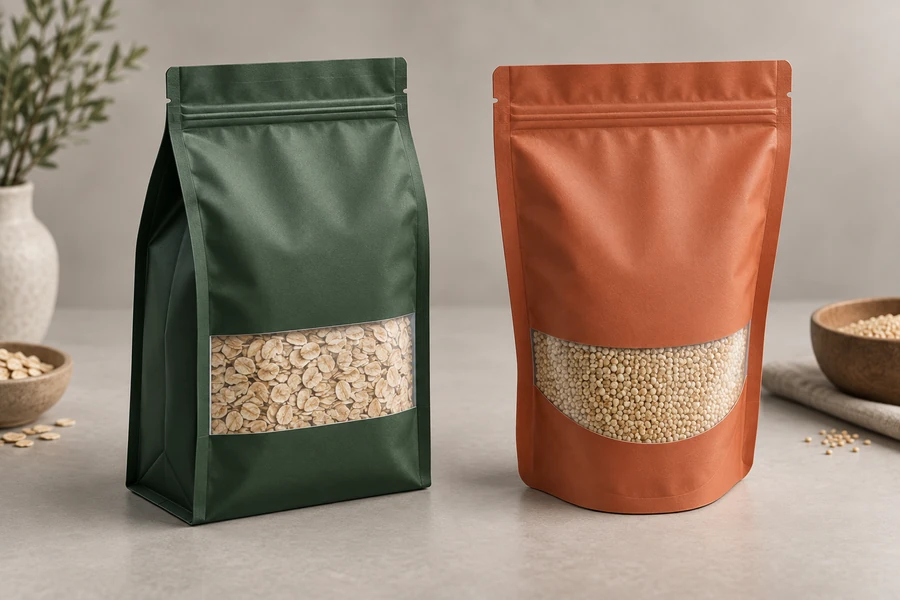
A stand-up pouch normally has a front panel, back panel, and folded bottom gusset. A flat bottom pouch normally adds two side gussets and a separate or clearly defined rectangular bottom panel. This gives the flat bottom pouch a more rigid, box-like profile, while the stand-up pouch remains softer and more flexible.
How a Stand-Up Pouch Is Built
A standard stand-up pouch is relatively simple.
It usually consists of:
- Front panel
- Back panel
- Bottom gusset
- Side seals
- Top filling and sealing area
When the pouch is empty, the bottom gusset stays folded.
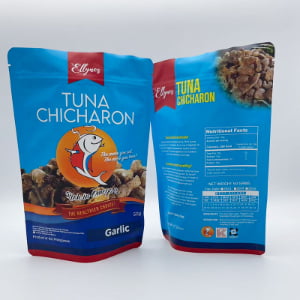
When I fill the pouch, the gusset expands outward and creates a footprint beneath the product. That expanded section allows the package to stand.
The filled shape is usually softer and more rounded than a flat bottom pouch.
Depending on the product, I may use different gusset styles such as Doyen, K-seal, or plow-bottom configurations.
How a Flat Bottom Pouch Is Built
A flat bottom pouch is more structured.
It generally includes:
- Front panel
- Back panel
- Two side gussets
- Flat bottom panel
- More sealing positions
Once filled, it creates a wider rectangular base.
The side panels also become more defined.
Current comparisons describe the result as closer to a flexible box than a conventional pouch.
Basic Structure Comparison
| Feature | Stand-Up Pouch | Flat Bottom Pouch |
|---|---|---|
| Main standing structure | Bottom gusset | Flat rectangular base |
| Side gussets | Usually no | Yes |
| Filled shape | Softer and rounded | More structured and box-like |
| Number of defined panels | Fewer | More |
| Converting complexity | Lower | Higher |
| Standing ability | Good | Excellent |
| Empty storage | Very compact | Compact |
For me, this structural difference is the starting point for every other comparison.
Which Pouch Has Better Shelf Stability?
Both formats are designed to stand, but I generally give flat bottom pouches the advantage when stability matters most.
Flat bottom pouches usually offer better shelf stability because their broad rectangular base distributes product weight across a larger, flatter footprint. Stand-up pouches also stand well, but their flexible bottom gusset can make them more sensitive to fill level, product density, pouch dimensions, and the way the product settles after filling.
The Flat Base Creates a Wider Footprint
A flat bottom bag sits on a defined base rather than depending mainly on a folded gusset.
This can be useful for:
- Coffee
- Nuts
- Granola
- Pet treats
- Tea
- Powders
- Larger premium snack packages
The structured base gives the pouch a cleaner vertical profile.
This can also make several units look more organized when they are placed next to each other on a shelf.
Stand-Up Pouches Still Perform Very Well
I would not describe stand-up pouches as unstable.
They are specifically designed to stand.
For many products, they perform perfectly well.
Problems usually appear when the pouch dimensions and actual fill are poorly matched.
For example, a tall pouch with too little product may slump.
A lightweight product may not create enough pressure to fully open the gusset.
A very dense or top-heavy product may make a narrow pouch easier to tip.
Recent pouch design guidance also notes that fill level can strongly affect how a stand-up pouch presents its front panel and base.
I Always Test With the Actual Product
I do not select pouch dimensions from net weight alone.
A 250 g powder, 250 g coffee bean pack, and 250 g snack product can occupy very different volumes.
I prefer an actual fill test.
I check:
- Does the base open fully?
- Does the pouch lean?
- Is the front panel smooth enough?
- Is there enough headspace?
- Does the zipper sit above the product?
- Does the package remain stable after shipping simulation?
This is more reliable than approving a pouch only from a digital mockup.
Which Pouch Offers More Branding and Printing Space?
Both formats provide large printable surfaces, but flat bottom pouches give me more clearly separated panels.
Flat bottom pouches generally provide more structured branding space because the front, back, two side gussets, and bottom can be treated as separate design surfaces. Stand-up pouches offer strong front and back graphics but have fewer defined panels, and the lower front area can curve as the bottom gusset opens.
Flat Bottom Pouches Give Me More Information Zones
I can organize a flat bottom pouch like this:
Front panel: logo, product name, hero image.
Side panel 1: flavor, origin, product story.
Side panel 2: preparation instructions or key benefits.
Back panel: ingredients, nutrition, barcode, regulatory information.
This organization can work especially well for specialty coffee, premium tea, gourmet snacks, pet food, and supplements.
The package can carry a lot of information without making the main front design too crowded.
Stand-Up Pouches Give Me a Strong Main Billboard
Stand-up pouches still provide excellent branding.
Their large front panel can work very well for:
- Logo
- Product photography
- Flavor
- Claims
- Certifications
- Main selling points
The back can handle more detailed information.
For many brands, that is already enough.
The lower area may curve once the gusset expands, so I avoid placing critical text too close to areas likely to distort.
Packaging Space Should Serve the Product
I do not choose a flat bottom pouch merely because it has more printable surfaces.
If a brand only needs a logo, product name, short description, and standard back-panel information, a stand-up pouch may provide more than enough space.
More panels are useful only when I have a reason to use them.
Which Is More Cost-Effective: Flat Bottom or Stand-Up Pouches?
Stand-up pouches generally have the advantage when packaging cost is a primary concern.
Stand-up pouches are usually more cost-efficient because their structure uses fewer panels and fewer converting steps. Flat bottom pouches require additional side gussets, a more complex base, and more sealing operations. This can increase material use, production time, and unit cost, although exact pricing depends on size, material, printing, quantity, and features.
Structural Simplicity Affects Cost
A stand-up pouch normally has fewer components.
That can mean:
- Less complex forming
- Fewer sealing areas
- Simpler production
- Lower material use in many comparable applications
A flat bottom pouch requires more forming and sealing work.
Its additional structure may also use more film.
This is why I usually begin with a stand-up pouch when a project is highly price-sensitive.
Unit Price Is Not the Only Cost
I still avoid making the decision only from pouch price.
I also consider:
- Filling speed
- Packing labor
- Shipping cartons
- Retail display
- Product damage
- Consumer convenience
- Secondary packaging
- Reject rate
A flat bottom bag may cost more per piece but create stronger shelf presentation.
If that premium structure supports a higher-value product, the cost can be justified.
My Cost Comparison
| Cost Factor | Stand-Up Pouch | Flat Bottom Pouch |
|---|---|---|
| Structure complexity | Lower | Higher |
| Converting steps | Fewer | More |
| Typical unit cost | Lower | Higher |
| Premium presentation | Good | Excellent |
| Empty storage efficiency | Excellent | Excellent |
| Potential retail value | Strong | Very strong |
I think the better question is not, “Which pouch is cheaper?”
I ask, “Does the additional structure create enough commercial value to justify its cost?”
Which Pouch Holds More Product?
Flat bottom pouches can use internal volume efficiently because their side gussets and broad base create a box-like cavity, but capacity always depends on dimensions and product density.
Flat bottom pouches often provide efficient internal volume and work well for larger or denser fills because the side gussets and rectangular base expand into a structured package. Stand-up pouches are also available in large sizes, but their capacity comes mainly from the bottom gusset, so the best format depends on the product's volume and weight distribution.
Weight Does Not Equal Volume
This point is easy to overlook.
One kilogram of coffee beans requires a different pouch volume from one kilogram of fine powder.
Large nuts occupy space differently from pet treats.
Granola can contain a lot of air between pieces.
That means I never choose pouch size using weight alone.
Flat Bottom Pouches Use Side Space Efficiently
The side gussets expand vertically.
This creates a more defined internal cavity.
For products that need higher fill volume while maintaining a relatively compact shelf footprint, this can be useful.
I often consider flat bottom pouches for:
- Coffee
- Large nut packs
- Pet food
- Granola
- Premium snacks
- Tea
However, the actual advantage depends on dimensions.
A badly sized flat bottom bag can still waste space.
Are Flat Bottom and Stand-Up Pouches Made From Different Materials?
Not necessarily. Both formats can use many of the same flexible packaging materials.
Flat bottom and stand-up pouches can use similar laminates, including PET/PE, PET/metallized PET/PE, foil laminates, PA/PE, and high-barrier mono-material structures. The pouch format mainly affects geometry and presentation, while the film structure determines properties such as oxygen barrier, moisture barrier, light protection, puncture resistance, and seal performance.
I Separate Structure From Barrier
This is one of the most important distinctions I make.
A flat bottom pouch does not automatically have better barrier performance.
A stand-up pouch does not automatically have weaker protection.
Either one can be built from:
- Transparent films
- Metallized laminates
- Aluminum foil structures
- High-barrier films
- Recyclable mono-material designs
The product determines the material.
The pouch shape determines how the package stands, fills, and presents itself.
The Same Coffee Could Use Either Format
For example, I could package the same roasted coffee in:
Flat bottom + PET/VMPET/PE
or
Stand-up pouch + PET/VMPET/PE
The barrier can be very similar.
The difference is mainly:
- Shelf shape
- Stability
- branding area
- Package cost
- Filling behavior
This is why I do not allow the pouch name to substitute for a material specification.
Which Pouch Is Better for Zippers, Valves, and Other Features?
Both formats can support most common flexible-packaging features.
Stand-up and flat bottom pouches can both include resealable zippers, tear notches, degassing valves, transparent windows, hang holes, matte finishes, and high-barrier materials. Flat bottom pouches often integrate premium zipper styles particularly well, while standard stand-up pouches offer broad compatibility with conventional press-to-close closures.
Common Features Include
- Press-to-close zipper
- Pocket zipper
- Pull-tab zipper
- Tear notch
- Coffee degassing valve
- Transparent window
- Laser scoring
- Hang hole
- Matte or gloss finish
- Spot decorative effects
I select these features according to how consumers use the product.
For coffee, I may add a valve.
For nuts, I may prioritize a zipper.
For a single-serving snack, I may not need either.
Adding every available feature usually increases cost without necessarily improving the package.
Which Pouch Works Better With Filling Equipment?
This question can be more important than branding because the wrong pouch can reduce production efficiency.
Stand-up pouches are commonly compatible with a wide range of premade-pouch filling systems. Flat bottom pouches can require equipment or machine settings capable of opening and controlling their more structured side and bottom panels. I always confirm machine compatibility before changing pouch format.
A More Complex Bag Can Need More Control
Flat bottom pouches have:
- More panels
- More gussets
- A wider structured base
- More defined corners
The filling machine has to open and position these correctly.
The top also needs to remain clean for final sealing.
Stand-Up Pouches Are Familiar to Many Filling Lines
Premade stand-up pouch fillers are widely used.
The typical sequence includes:
- Bag feeding
- Bag opening
- Product filling
- Zipper handling where applicable
- Top heat sealing
This familiarity can make stand-up pouches a safer starting point for businesses using existing pouch-filling equipment.
I Check the Machine Before Ordering Bags
Before changing from stand-up to flat bottom, I confirm:
- Maximum pouch width
- Pouch height
- Base dimensions
- Zipper position
- Filling opening
- Gripper compatibility
- Fill weight
- Product settling
- Final seal area
A package that cannot run efficiently can become expensive even if the empty pouch price looks competitive.
Which Products Are Best for Flat Bottom and Stand-Up Pouches?
I use both formats across food, pet food, supplements, coffee, tea, and other dry products, but I normally position them differently.
I use stand-up pouches when versatility, cost efficiency, reclosure, and broad retail use matter most. I use flat bottom pouches when premium presentation, larger fill volumes, stronger shelf stability, or multiple branding panels create enough value to justify a more complex structure.
Products I Often Put in Stand-Up Pouches
- Nuts
- Dried fruit
- Candy
- Snacks
- Protein powder
- Supplements
- Spices
- Pet treats
- Jerky
- Granola
- Small coffee packs
Products I Often Put in Flat Bottom Pouches
- Specialty coffee
- Premium tea
- Gourmet nuts
- Premium granola
- Pet food
- High-value snacks
- Larger dry-food packs
My Practical Product Comparison
| Product/Application | Format I Often Consider First |
|---|---|
| New snack brand | Stand-up pouch |
| Dried fruit | Stand-up pouch |
| Protein powder | Stand-up pouch |
| Trial-size product | Stand-up pouch |
| Specialty coffee | Flat bottom pouch |
| Premium nuts | Flat bottom pouch |
| High-end tea | Flat bottom pouch |
| Premium pet treats | Flat bottom or stand-up |
| E-commerce refill | Stand-up pouch |
| Premium supermarket shelf | Flat bottom pouch |
These are starting points, not fixed rules.
My Insights: What Are the Key Differences Between Flat Bottom Pouches and Stand-Up Pouches
I think the most useful comparison is not simply “premium versus economical.” The two formats solve different structural and commercial problems.
The key differences between flat bottom pouches and stand-up pouches are base construction, stability, panel layout, capacity, manufacturing complexity, cost, and filling behavior. Flat bottom pouches create a structured box-like package with a broad base and extra panels, while stand-up pouches provide a simpler, flexible, and generally more economical standing format.
I Think Shelf Stability Is the Strongest Reason to Choose Flat Bottom
If a product already stands perfectly in a stand-up pouch, I would not automatically move to flat bottom.
The strongest structural reason to change is usually better stability.
A wide rectangular base is especially useful when the product is:
- Dense
- Relatively heavy
- Tall
- Premium positioned
- Expected to form a clean shelf block
Current comparison guides consistently identify the broad base and defined panels as the main structural advantages of flat bottom packaging.
I Think Stand-Up Pouches Win When Flexibility Matters
Stand-up pouches can work across many categories and sizes.
They offer:
- Lower structural complexity
- Strong front graphics
- Zipper compatibility
- Compact empty storage
- Broad filling-line familiarity
- Generally lower cost
For new product development, this flexibility can be more valuable than having the most structured pouch.
I Would Not Pay for Extra Panels Unless I Need Them
Five defined surfaces sound attractive.
However, not every product needs that much design space.
If the brand identity works perfectly with front and back printing, a flat bottom pouch may create extra cost without solving a real problem.
I use the side panels when I have meaningful information to communicate.
Otherwise, I keep the structure simpler.
I Think Barrier Performance Should Be Specified Separately
This is one of the biggest purchasing mistakes I try to avoid.
Choosing a flat bottom pouch does not automatically mean the product has a longer shelf life.
Shelf-life protection depends more directly on:
- Film structure
- OTR
- WVTR
- Light barrier
- Seal quality
- Closure
- Filling process
- Storage conditions
I choose the pouch shape for physical and commercial behavior.
Then I engineer the material around the product.
I Think Actual Fill Testing Should Make the Final Decision
Current 2026 comparison guidance repeatedly recommends evaluating real product density, fill volume, dimensions, and filling equipment instead of selecting only from pouch photographs.
I agree with that approach.
My final prototype should answer:
- Does it stand?
- Does it look full?
- Does it seal reliably?
- Does the zipper remain clean?
- Does it fit shipping cartons efficiently?
- Can the filling line handle it?
- Does the final package support the desired retail position?
My Final Comparison
| Decision Factor | Stand-Up Pouch | Flat Bottom Pouch |
|---|---|---|
| Bottom design | Expandable gusset | Defined rectangular base |
| Side gussets | Usually no | Yes |
| Filled shape | Flexible | Structured |
| Shelf stability | Good | Excellent |
| Branding panels | Front/back focused | Multiple defined panels |
| Typical cost | Lower | Higher |
| Production complexity | Lower | Higher |
| Premium appearance | Strong | Very strong |
| Zipper options | Excellent | Excellent |
| Barrier material options | Broad | Broad |
| E-commerce | Excellent | Good |
| Premium retail | Strong | Excellent |
| Filling flexibility | Broad | Requires more checking |
| Larger/heavier fills | Possible | Often advantageous |
For me, the final choice is straightforward.
I choose a stand-up pouch when I need a cost-efficient, flexible format with strong shelf presence and familiar consumer convenience.
I choose a flat bottom pouch when I need a wider base, better structural stability, more defined branding panels, and a more premium box-like presentation.
Neither format is universally better.
The correct choice depends on whether the extra structure of the flat bottom pouch creates enough value for the product, filling line, sales channel, and brand.
Conclusion
Flat bottom pouches offer stronger structure, stability, and branding panels, while stand-up pouches provide greater simplicity, flexibility, and cost efficiency. I choose between them based on the real product and packaging system.