
](https://www.sglpackaging.com/wp-content/uploads/2026/09/What-Is-the-Best-Packaging-for-Frozen-Food.webp "What Is the Best Packaging for Frozen Food? 1")
Frozen food can stay safe for a long time, but poor packaging can still cause freezer burn, broken seals, dehydration, odor transfer, and serious quality loss.
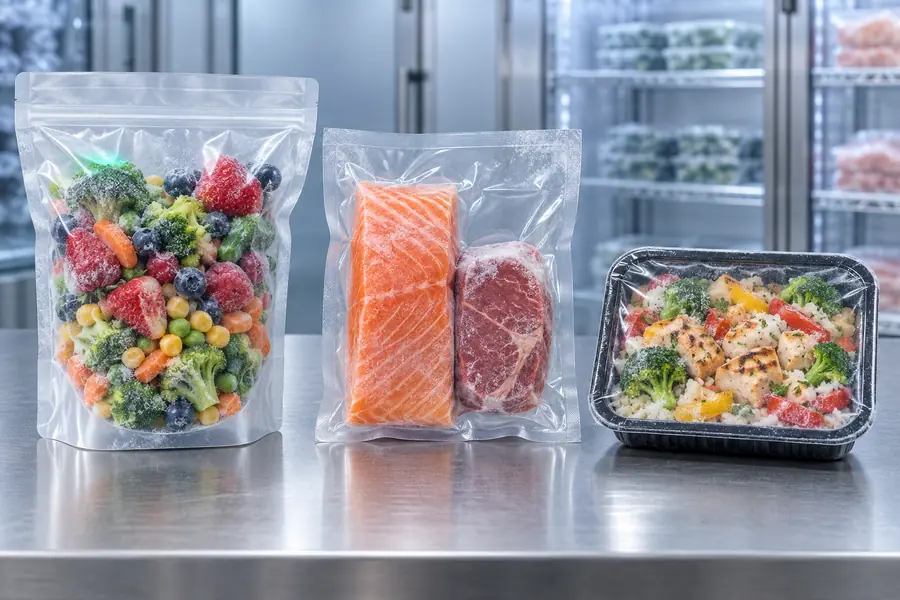
The best packaging for frozen food is moisture-vapor resistant, airtight, leakproof, puncture resistant, and flexible at low temperatures. I usually choose PE-based flexible pouches for frozen vegetables and fruit, vacuum barrier bags for meat and seafood, and rigid or semi-rigid trays with lidding film for frozen ready meals.
I do not select frozen food packaging only by pouch style. I first consider the food's shape, fat content, sharp edges, storage period, filling process, reheating method, freezer temperature, and cold-chain conditions. Those factors determine the film, seal, barrier, and package structure I need.
What Type of Packaging Is Best for Frozen Food?
There is no single frozen food package that works best for vegetables, meat, seafood, pizza, ready meals, and ice cream because these products create very different packaging stresses.
For most commercial frozen foods, I prefer a freezer-grade flexible pouch or film that remains tough at low temperatures and provides strong moisture protection. Stand-up or gusseted bags work well for vegetables, fruit, and snacks. Vacuum bags are better for meat and seafood, while lidded trays are useful for complete meals and products reheated in their package.
I Start With Low-Temperature Performance
Ordinary room-temperature packaging is not automatically suitable for frozen distribution.
The package may experience freezing, stacking, impacts, vibration, sharp ice crystals, and repeated handling while cold.
The National Center for Home Food Preservation lists several important requirements for freezer packaging. It should be moisture-vapor resistant, durable, leakproof, resistant to oils and water, easy to seal, and able to avoid becoming brittle or cracking at low temperatures.
I use the same basic logic when evaluating commercial frozen packaging.
A package that performs well at room temperature may fail when frozen if:
- The film becomes brittle.
- The seal cracks.
- A frozen product edge punctures the film.
- Flexing creates small pinholes.
- Moisture vapor escapes too easily.
- The zipper becomes difficult to use.
This is why polyethylene-based structures are common in frozen food applications. PE can provide useful low-temperature flexibility and heat-sealing performance.
Commercial frozen-food films can also combine PE with other materials to improve stiffness, puncture resistance, oxygen barrier, or printing.
I Match the Package Format to the Product
| Frozen Product | Packaging I Usually Consider |
|---|---|
| Frozen vegetables | Pillow bag or stand-up pouch |
| Frozen berries | Stand-up or gusseted pouch |
| Frozen French fries | Large pillow/gusset bag |
| Frozen dumplings | Flat or pillow bag |
| Frozen meat | Vacuum bag |
| Frozen seafood | Vacuum/high-barrier pouch |
| Frozen pizza | Inner wrap + paperboard carton |
| Frozen ready meal | Tray + lidding film |
| Frozen soup | Freezer-grade pouch or rigid container |
| Ice cream | Coated paperboard/plastic tub |
| Frozen appetizers | Pillow or stand-up pouch |
| Family-size frozen food | Gusseted pouch |
I treat this table as a starting point.
The final specification still depends on how long the product must remain frozen and how rough the distribution system is.
Why Does Frozen Food Need Special Packaging?
Freezing slows food deterioration, but the freezer environment itself can damage food quality when packaging allows too much air or water-vapor movement.
Frozen food needs special packaging mainly to limit moisture loss and air exposure while surviving cold temperatures without cracking. Poor packaging can lead to freezer burn, flavor changes, dehydration, odor absorption, oxidation, and physical damage. USDA guidance confirms that freezer burn occurs when air contacts the food surface and dries it.
I Consider Freezer Burn a Packaging Problem
Freezer burn creates dry, leathery areas on frozen food.
USDA explains that it is caused by air reaching the surface of the food. Freezer burn does not automatically make food unsafe, but it can significantly reduce eating quality.
This distinction matters.
Frozen food packaging is not only about microbial safety.
It is also about preserving:
- Moisture
- Flavor
- Color
- Texture
- Aroma
- Appearance
USDA also notes that thin supermarket wrapping can allow air through, which is why heavier airtight freezer wrapping is recommended for longer storage.
For commercial packaging, I apply the same principle.
If a frozen product has a long retail shelf life, I pay more attention to moisture-vapor transmission and seal integrity.
Moisture Barrier Is Often More Important Than Buyers Expect
Frozen food is surrounded by very dry freezer air.
If moisture can move through the package, the product may slowly lose water.
Ice can migrate or sublime from the food surface.
The National Center for Home Food Preservation therefore lists moisture-vapor resistance as one of the key requirements for freezer packaging.
I consider this particularly important for:
- Frozen meat
- Seafood
- Frozen fruit
- Ice cream
- Frozen prepared meals
- Products stored for long periods
The packaging does not need the maximum possible barrier for every food.
It needs enough protection to achieve the required commercial shelf life.
Oxygen Barrier Depends on the Product
Moisture is not the only concern.
Products containing fat can also be affected by oxygen.
Frozen meat, seafood, cheese-containing meals, and fatty prepared foods may therefore benefit from stronger oxygen protection.
Amcor's current forming films for fresh and frozen foods emphasize oxygen barrier, moisture barrier, toughness, and puncture resistance together rather than treating one property as the entire specification.
I think that combination is a useful way to evaluate frozen food films.
Which Packaging Materials Are Best for Frozen Food?
I usually prefer material structures that combine low-temperature flexibility with moisture resistance, seal strength, and enough mechanical toughness for the product.
PE and LLDPE are common frozen-food packaging materials because they remain flexible and heat seal well at low temperatures. I may combine PE with PET, PA/nylon, EVOH, or other barrier layers when the food needs greater puncture resistance, stiffness, oxygen protection, or printing performance.
PE Is Often My Starting Point
Polyethylene is widely used in freezer packaging.
I may use it as:
- A mono-material pouch structure
- A sealant layer
- A freezer bag
- A component of a laminated film
PE can provide a useful combination of flexibility and sealability.
This becomes important when frozen packages are dropped or compressed.
A brittle package can crack instead of flexing.
Nylon Can Improve Puncture Resistance
Frozen meat and seafood can have hard or sharp edges.
Bones, shells, frozen corners, and ice crystals can create concentrated pressure on the film.
For these products, I often evaluate PA, also called nylon.
A structure such as:
PA / PE
can provide toughness and sealing performance.
For a more complex application, I might consider structures containing PET, PA, EVOH, and PE depending on barrier requirements.
PET Can Add Stiffness and Print Quality
PET is often used as an outer web in laminated flexible packaging.
It can provide:
- Stiffness
- Printing performance
- Heat resistance
- Mechanical strength
A PET/PE structure can work for selected frozen products when the barrier requirements are moderate.
If I need more oxygen protection, I may add another functional barrier layer.
EVOH Can Increase Oxygen Barrier
EVOH is commonly used when strong oxygen protection is needed.
I may consider it for:
- Frozen meat
- Seafood
- High-fat ready meals
- Cheese-containing foods
- Long shelf-life products
However, barrier performance needs to be evaluated in the complete structure.
I do not specify EVOH simply because it sounds more advanced.
My Material Selection Framework
| Material | Main Role I Consider |
|---|---|
| LDPE/LLDPE | Low-temperature flexibility and sealing |
| PE | Moisture resistance and sealability |
| PET | Stiffness and printing |
| PA/Nylon | Puncture and impact resistance |
| EVOH | Oxygen barrier |
| Aluminum foil | Very high light/gas barrier in specialized structures |
| Paperboard | Rigidity and secondary protection |
A recent 2026 review of frozen-food packaging also identifies PE, PA, PP, PET, and EVOH among the material families used in frozen packaging systems.
Is Vacuum Packaging Best for Frozen Meat and Seafood?
I usually give vacuum packaging serious consideration when the frozen product is meat, poultry, fish, or seafood because direct air contact is a major quality concern.
Vacuum packaging is one of the best choices for frozen meat and seafood because it removes most of the air before sealing. This reduces direct oxygen exposure and limits the air space associated with freezer burn. The bag still needs strong seals, puncture resistance, and suitable moisture and oxygen barriers.
Vacuum Packaging Removes Air Around the Food
USDA describes vacuum packaging as removing substantially all air from a rigid or flexible package before sealing. Reducing oxygen can slow chemical deterioration and help preserve product quality.
For frozen meat, this gives me several practical benefits.
The film sits close to the food.
There is less free air around the surface.
The pack can become compact.
The consumer can also see the product when a transparent high-barrier film is used.
I Pay More Attention to Punctures
Vacuum pressure pulls the film tightly around the product.
This means sharp areas become more important.
I check:
- Exposed bones
- Shells
- Hard corners
- Frozen edges
- Product clips
- Uneven surfaces
A bag can have excellent oxygen barrier and still fail if a bone creates a pinhole.
This is where nylon-containing films or thicker puncture-resistant structures can become useful.
Vacuum Packaging Is Not Best for Everything
I would not automatically vacuum-pack delicate frozen berries.
The pressure could compress the product.
I also would not use it for every frozen dumpling or French fry product because conventional form-fill-seal bags may be more efficient.
I therefore see vacuum packaging as especially useful for products where reducing air contact is more important than maintaining internal cushioning.
Are Stand-Up Pouches Good for Frozen Vegetables and Fruit?
Yes. I often consider stand-up or gusseted pouches for retail frozen fruit and vegetables because they combine good freezer performance with strong merchandising.
Stand-up pouches work well for frozen vegetables, berries, fruit, potato products, appetizers, and similar retail foods when the film is designed for frozen use. I look for low-temperature toughness, strong seals, moisture resistance, puncture resistance, and enough stiffness for the pouch to remain practical after repeated freezer handling.
Stand-Up Pouches Improve Consumer Convenience
A conventional pillow bag works very well for high-volume frozen vegetables.
However, a stand-up pouch can add:
- Upright presentation
- Zipper reclosure
- Easier pouring
- Better refrigerator/freezer organization
- Larger front branding area
For multi-serving frozen fruit or vegetables, I think a zipper can add real consumer value.
The consumer may remove one serving and return the rest to the freezer.
I still want a strong original heat seal above the zipper before first opening.
Pillow Bags Remain Very Efficient
I would not choose a stand-up pouch only because it looks premium.
For high-volume products such as:
- Frozen peas
- Corn
- Mixed vegetables
- French fries
- Frozen fruit
a pillow or gusseted form-fill-seal bag may provide excellent production economics.
The packaging line can form, fill, and seal the bag from rollstock at high speed.
This can reduce conversion and handling steps.
Frozen Food Films Need Strong Cold Seals
The package can experience impacts after the food becomes hard.
This can place stress on seals and gussets.
ProAmpac currently offers PE-based frozen-food films designed specifically for cold-chain applications and highlights seal strength, low-temperature performance, and compatibility with vertical form-fill-seal equipment, including gusseted and stand-up pouch formats.
For me, this confirms an important principle:
A normal stand-up pouch and a freezer-grade stand-up pouch are not automatically the same thing.
What Packaging Is Best for Frozen Ready Meals?
I usually prefer a tray-based system when the package needs to protect the meal's shape and possibly move directly into a microwave or oven.
Frozen ready meals often work best in rigid or semi-rigid trays sealed with lidding film and supported by an outer carton when needed. This structure can separate food components, protect the meal during distribution, provide cooking convenience, and support microwaveable or ovenable applications when the materials are specifically designed for those conditions.
Trays Give Me More Structural Protection
A flexible pouch is efficient, but it does not hold a meal in a fixed shape.
A tray can protect:
- Pasta
- Rice dishes
- Meat portions
- Sauces
- Vegetables
- Complete frozen dinners
The tray also makes portion control easier.
I can use compartments to separate products that require different textures or cooking behavior.
Lidding Film Becomes Part of the Barrier
The tray alone is not the entire package.
I also select the lidding film.
Depending on the application, I may need:
- Strong permanent seal
- Peelable opening
- Anti-fog properties
- Oxygen barrier
- Moisture barrier
- Microwave venting
- Oven compatibility
I never assume a conventional plastic tray can go from freezer directly to oven.
The complete tray and lid system must be designed for the intended reheating process.
Paperboard Cartons Can Provide Secondary Protection
Many frozen meals include an outer carton.
This gives me:
- Better stacking
- Branding area
- Cooking instructions
- Barcode space
- Mechanical protection
However, plain paperboard alone is generally not enough as the primary long-term moisture barrier for frozen food.
The National Center for Home Food Preservation notes that common unlined cartons are not sufficiently moisture-vapor resistant for extended freezer storage.
I therefore treat the carton mainly as structural and communication packaging unless it has an appropriate liner or coating.
Is Recyclable Packaging Suitable for Frozen Food?
I see recycling-oriented frozen-food packaging improving, especially in PE-based flexible films, but I still prioritize cold-chain performance.
Recycle-ready mono-material PE frozen-food films can be suitable for products such as vegetables, fruit, potatoes, appetizers, and other frozen foods when they provide the required seal strength and low-temperature toughness. I still verify actual local recycling acceptance because “mono-material” does not mean the package is collected everywhere.
Mono-PE Frozen Films Are Becoming More Practical
Traditional frozen-food packaging may use several polymer layers.
Those combinations can deliver excellent performance but may be difficult to recycle.
Newer structures try to provide stiffness, sealability, and freezer performance within a PE-dominant package.
ProAmpac currently markets PE-based recyclable frozen-food films for products including frozen fruits, vegetables, potatoes, snacks, and appetizers. Its R-500F structure is designed for vertical form-fill-seal equipment and low-temperature distribution.
This is important because sustainability cannot come at the expense of actual line performance.
A new material must still:
- Run on the packaging machine
- Seal consistently
- Survive frozen drops
- Resist flex cracking
- Protect against moisture
- Maintain print quality
I Also Consider Food Waste
I think this point is sometimes missed.
Frozen food packaging uses material, but it also protects food with significant production, processing, refrigeration, and transportation inputs.
If a downgauged or simplified package creates freezer burn, leaks, or breakage, product waste can increase.
I therefore use the minimum structure that reliably meets the product's protection requirements.
That is more useful than reducing packaging simply for appearance.
My Insights: What Is the Best Packaging for Frozen Food
I think the best frozen-food package is not the one with the most layers. It is the one that remains intact from filling through freezing, shipping, retail storage, consumer handling, and preparation.
The best packaging for frozen food combines low-temperature toughness, moisture-vapor resistance, strong sealing, puncture protection, and the right oxygen barrier for the product. I usually choose flexible freezer pouches for vegetables and fruit, vacuum barrier bags for meat and seafood, and lidded trays for ready meals. The product and cold chain should determine the final structure.
I Think Low-Temperature Toughness Should Come Before Premium Appearance
Frozen packages experience unusual mechanical stress.
A pouch may look excellent at room temperature and become brittle after freezing.
Once the food becomes hard, the product itself can behave like a rigid object inside the package.
Corners become sharper.
Impacts become more severe.
This is why I prioritize:
- Seal integrity.
- Low-temperature flexibility.
- Puncture resistance.
- Moisture barrier.
- Oxygen barrier.
- Graphics and finishing.
The order can change with the product, but I never put premium printing ahead of physical package performance.
I Think Freezer Burn Is a System Problem
Many buyers try to solve freezer burn by asking for “higher barrier film.”
Sometimes that is correct.
However, I also inspect:
- Excess headspace
- Weak top seals
- Zipper leakage
- Punctures
- Poor vacuum
- Incorrect package size
- Long storage periods
USDA specifically connects freezer burn with air reaching the product surface.
This means a poorly sealed high-barrier pouch may perform worse than a properly sealed simpler package.
I Would Not Use the Same Bag for Frozen Berries and Bone-In Meat
The temperature may be the same.
The mechanical demands are not.
Frozen berries are relatively light and may need protection from dehydration and crushing.
Bone-in meat can puncture film.
Seafood may include shells or sharp tails.
A pizza needs shape protection.
Soup creates leak and expansion concerns.
The package specification therefore needs to begin with the product geometry.
I Think Consumer Preparation Should Influence the Package
Frozen food increasingly moves directly from freezer to preparation.
If the consumer needs to:
- Microwave the package
- Boil the pouch
- Steam through a vent
- Bake in the tray
I treat that as a major material-selection requirement.
A freezer-safe material is not automatically microwave-safe or oven-safe.
The use conditions need to be part of the specification from the beginning.
My Practical Frozen Food Packaging Framework
| If I Am Packaging... | My First Choice |
|---|---|
| Frozen vegetables | Pillow/gusseted freezer bag |
| Frozen berries | Stand-up or gusseted pouch |
| Frozen French fries | Large VFFS bag |
| Frozen dumplings | Flat or pillow pouch |
| Frozen chicken | High-strength freezer/vacuum bag |
| Frozen beef | Vacuum barrier pouch |
| Frozen seafood | Puncture-resistant vacuum pouch |
| Frozen ready meal | Tray + lidding film |
| Frozen pizza | Protective wrap + carton |
| Frozen soup | Leak-resistant pouch or rigid container |
| Multi-serving frozen food | Resealable freezer pouch |
| Recycling-oriented frozen vegetables | Qualified mono-PE freezer film |
For me, this is why I would not answer “What is the best packaging for frozen food?” with only one material name.
For frozen peas, an efficient PE-based form-fill-seal bag may be ideal.
For frozen shrimp, I may need a tough vacuum barrier pouch.
For a frozen curry meal, I may need a rigid microwaveable tray and lidding film.
For family-size frozen fruit, I may choose a resealable stand-up pouch.
The best packaging is the one engineered around the exact frozen product, storage period, machine, cold-chain environment, and consumer use.
Conclusion
I choose frozen-food packaging for cold toughness, moisture protection, seal strength, and puncture resistance first, then match pouches, vacuum bags, or trays to the specific product.