
](https://www.sglpackaging.com/wp-content/uploads/2026/09/Top-3-Bag-Types-of-Nut-Packaging-for-Your-Business.webp "Top 3 Bag Types of Nut Packaging for Your Business 1")
Nuts can lose crunch, aroma, and flavor when packaging allows too much oxygen, moisture, or light inside. Choosing the wrong bag can shorten shelf life before consumers notice visible damage.
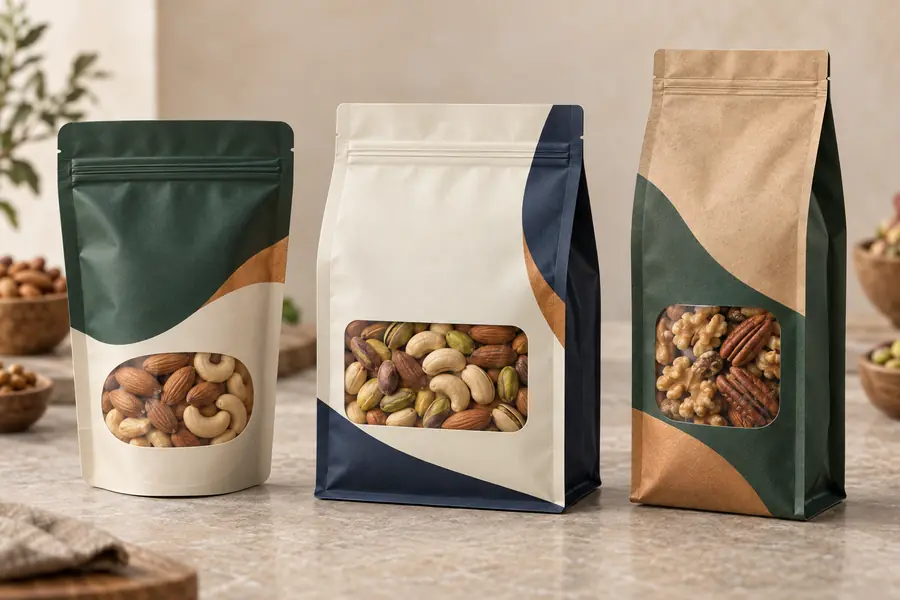
The top three nut packaging bag types I recommend for most businesses are stand-up pouches, flat bottom bags, and side gusset bags. Stand-up pouches offer the best all-around balance, flat bottom bags suit premium retail products, and side gusset bags provide efficient capacity for larger fills and traditional packaging programs.
I do not choose among these three formats only by appearance. Nuts contain natural oils that can oxidize, while moisture can affect their crisp texture. I therefore consider the bag structure together with oxygen barrier, moisture barrier, light protection, zipper design, nitrogen flushing, seal quality, filling equipment, pack size, and target shelf life.
Why Are Stand-Up Pouches One of the Best Nut Packaging Bags?
When I need one flexible format that works across a wide range of retail nut products, I usually start with a stand-up pouch.
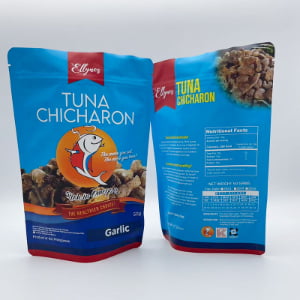
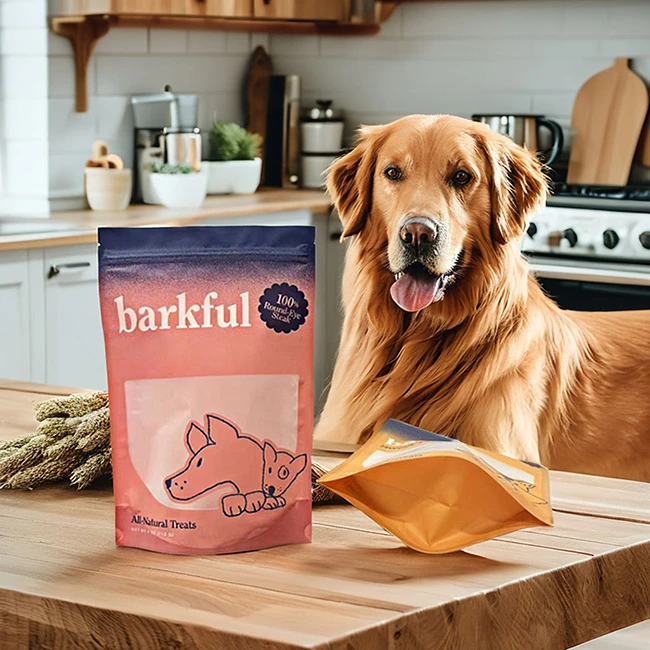
Stand-up pouches are one of the best nut packaging choices because their bottom gusset creates an upright retail package while supporting high-barrier films, resealable zippers, tear notches, windows, and custom printing. I often use them for almonds, cashews, pistachios, peanuts, seeds, trail mix, and dried-fruit-and-nut blends.
I Like the Balance Between Cost and Shelf Presence
A stand-up pouch uses a folded bottom gusset.
When I fill the bag, the gusset expands and gives the package a stable base. The pouch can then stand with its main graphic panel facing consumers.
This solves two problems at the same time.
I gain a flexible package that stores flat before filling, but I still get an upright retail presentation afterward.
For many growing nut brands, this is enough structure without moving to a more complex flat bottom bag.
Current comparisons between flexible formats describe stand-up pouches as a broad retail option that balances functionality, print area, closures, barrier structures, and cost.
I commonly consider them for:
- Almonds
- Cashews
- Walnuts
- Pistachios
- Pecans
- Peanuts
- Mixed nuts
- Trail mix
- Seeds
- Dried fruit and nut mixes
Zippers Add Real Value for Nuts
A resealable zipper makes particular sense in this category.
Consumers often eat nuts over several occasions instead of finishing an entire family-size package at once.
I therefore like a structure with:
- A permanent heat seal above the zipper.
- A tear notch or easy-open feature.
- A press-to-close zipper for later use.
The original heat seal protects the unopened package.
The zipper supports consumer reclosure after opening.
Current nut packaging suppliers commonly use resealable zipper systems specifically to help protect multi-serving nuts from repeated exposure to moisture and air.
Stand-Up Pouches Can Use Different Barrier Materials
The standing shape itself does not preserve the nuts.
The film structure does much of that work.
Depending on the shelf-life target, I may consider:
- PET/PE
- PET/metallized PET/PE
- BOPP/metallized BOPP/CPP
- Foil-based laminates
- Transparent high-barrier structures
- High-barrier mono-material alternatives
Metallized films are commonly used for nuts because they can improve oxygen, moisture, and light protection at a practical cost. For more demanding shelf-life targets, foil-based structures can provide stronger barrier performance.
When I Choose a Stand-Up Pouch
| Business Requirement | Stand-Up Pouch Fit |
|---|---|
| General retail nuts | Excellent |
| Multi-serving product | Excellent |
| Zipper required | Excellent |
| Strong front branding | Excellent |
| E-commerce | Excellent |
| Product samples | Possible, but flat pouches may be simpler |
| Premium luxury positioning | Good |
| Very large bulk fills | Possible, but gusseted formats may be better |
For me, the stand-up pouch is usually the safest starting point when a business wants one practical nut packaging format that works across several SKUs.
Why Are Flat Bottom Bags Good for Premium Nut Packaging?
When retail presentation is a major part of the brand strategy, I usually move from a standard stand-up pouch to a flat bottom structure.
Flat bottom bags are ideal for premium nut packaging because their rectangular base creates stronger shelf stability and a structured, box-like appearance. They also provide several defined printing panels for branding, product details, nutrition information, and storytelling while still supporting high-barrier films and resealable zipper systems.
The Box-Like Shape Changes Shelf Presentation
A flat bottom pouch has a more defined structure than a typical Doypack.
It normally includes:
- Front panel
- Back panel
- Two side gussets
- Flat rectangular bottom
Depending on construction, these surfaces can give me more distinct areas for artwork.
I can place the main logo and nut variety on the front.
I can use one side for sourcing or flavor information.
I can use the other side for ingredients, serving ideas, or product claims.
The back can carry nutrition information, barcode, and regulatory content.
Current flat bottom pouch guidance consistently highlights this multi-panel layout and the strong shelf stability created by the defined base.
I Use Flat Bottom Bags for Higher-Value Nut Products
I often consider them for:
- Premium pistachios
- Specialty almonds
- Organic nuts
- Flavored cashews
- Gourmet nut mixes
- Gift-oriented snacks
- Family-size premium nut products
- Premium trail mixes
The package feels more structured in the consumer's hand.
That does not automatically make the product better, but it can support a premium retail position when the materials, graphics, printing, and food quality match the presentation.
Larger Nut Pieces Can Benefit From the Stable Base
Large nuts and mixed products can create an uneven center of gravity inside a flexible package.
The wider rectangular base of a flat bottom bag can improve shelf stability.
Some current nut packaging suppliers specifically position flat bottom bags for larger fills or products that need a stronger retail base.
That can become especially useful for 500 g, 1 kg, or larger family-size packages.
I still perform an actual fill test.
Nuts have different bulk densities.
A kilogram of small peanuts will not occupy exactly the same volume as a kilogram of large in-shell pistachios or mixed nuts.
The Main Trade-Off Is Complexity
Flat bottom bags are usually more complex to convert than basic stand-up pouches.
They contain more defined panels and seals.
This can influence:
- Unit cost
- MOQ
- Filling compatibility
- Artwork preparation
- Production setup
I therefore use them when the additional structure creates clear value.
If a business sells mainly online and does not need a premium shelf block, a simpler stand-up pouch may provide a better total-cost balance.
Stand-Up vs Flat Bottom for Nuts
| Factor | Stand-Up Pouch | Flat Bottom Bag |
|---|---|---|
| Shelf stability | Good | Excellent |
| Premium appearance | Good | Excellent |
| Zipper options | Excellent | Excellent |
| Printing area | Strong front/back | Multiple defined panels |
| Structural complexity | Lower | Higher |
| Cost efficiency | Usually stronger | Usually higher cost |
| E-commerce | Excellent | Good |
| Premium supermarket retail | Strong | Excellent |
| Large nut packs | Good | Excellent |
I choose flat bottom bags when the package itself is expected to play a larger role in premium brand presentation.
When Should I Use Side Gusset Bags for Nuts?
Side gusset bags are less visually trendy than some newer pouch styles, but I still consider them very useful for the right commercial program.
Side gusset bags are a strong choice for larger nut quantities, traditional packaging programs, wholesale applications, and products that need expandable internal volume. Their folded side panels open as the bag fills, creating additional capacity without requiring the more complex rectangular base of a flat bottom pouch.
Side Gussets Create Efficient Capacity
A side gusset bag has folds running along the left and right sides.
These folds remain compact when the bag is empty.
As nuts enter the package, the gussets expand.
This provides more internal space than a simple lay-flat pouch.
I may consider the format for:
- Bulk nuts
- Large family packs
- Food-service nuts
- Wholesale products
- Large snack mixes
- Retail refill packs
Gusseted packaging is especially useful when a product is bulky because the expandable panels allow the bag to accommodate more volume without simply making the entire front panel wider.
The Format Can Work Well With Traditional Filling Operations
Side gusset bags have a long history in dry-food packaging.
Depending on the exact construction, the bag can be filled manually, semi-automatically, or through automated equipment.
I still check:
- Mouth opening
- Gusset dimensions
- Bag length
- Fill weight
- Top seal area
- Zipper design if required
- Filling equipment
The bag may also use a center or back seal depending on the manufacturing structure.
I Still Need a High-Barrier Film
A side gusset does not automatically make the bag better for freshness.
Just like a stand-up or flat bottom bag, it needs the correct material.
If I am packaging roasted nuts, I may prioritize oxygen and light protection more strongly because their oils can oxidize.
For a basic raw nut with a shorter distribution period, I may use a different barrier level.
Current nut packaging guidance identifies foil laminates and high-barrier metallized films as common choices when protection against oxygen and light is a priority.
Why I Do Not Automatically Replace Side Gussets With Flat Bottom Bags
Flat bottom pouches look more structured.
That does not mean they are always commercially better.
If I need:
- Efficient high-volume packing
- Large internal volume
- Traditional packaging equipment
- Lower structural complexity
- Wholesale rather than premium retail presentation
the side gusset bag can be the more logical choice.
Where Side Gusset Bags Fit
| Application | My View |
|---|---|
| Small premium snack pouch | Not my first choice |
| Large family-size nuts | Strong |
| Bulk food service | Strong |
| Wholesale nuts | Strong |
| Premium boutique display | Flat bottom may be better |
| Traditional dry-food line | Strong |
| High internal volume | Strong |
| Compact single-serve | Flat pouch is usually better |
For me, the side gusset bag wins when capacity and production practicality matter more than a rigid box-like shelf shape.
What Barrier Materials and Features Should Nut Packaging Have?
The bag type helps sell and handle the product, but material and closure choices determine whether the nuts remain fresh.
Nut packaging should usually limit oxygen, moisture, and light exposure while providing strong seals and enough puncture resistance for the product. I often add a zipper for multi-serving products and consider nitrogen flushing for longer shelf life. Metallized and foil laminates are common when stronger oxygen and light protection are required.
Oxygen Is One of My Main Concerns
Nuts contain oils.
Those oils can oxidize over time and produce rancid flavors and odors.
This makes oxygen barrier an important packaging property, especially for:
- Roasted nuts
- Salted nuts
- Flavored nuts
- High-fat varieties
- Long shelf-life products
I therefore ask for actual film-barrier specifications rather than choosing a laminate because it looks thick or metallic.
Moisture Changes Texture
Nuts are usually valued for crunch.
If they absorb enough moisture from humid air, that texture can deteriorate.
I therefore need both a suitable film and a reliable seal.
The zipper can help after opening, but I do not treat it as the original hermetic closure.
Light Protection Can Matter
Metallized and foil films block much more light than transparent structures.
This can help protect oil-rich snacks from light-related oxidation.
However, consumers often like seeing the nuts.
That creates a trade-off.
I may use a small transparent window rather than making the entire package clear.
Current nut packaging guidance specifically notes that clear windows improve product visibility but reduce barrier performance in the transparent area, so window size should be balanced against shelf-life requirements.
Nitrogen Flushing Can Support Shelf Life
Nitrogen flushing replaces much of the oxygen-containing air inside the bag with nitrogen before sealing.
For nuts, this can reduce the amount of oxygen available for oxidation.
It can also provide internal cushioning for fragile snack mixtures.
Current flexible packaging guidance for nuts describes nitrogen flushing as a way to displace oxygen and support shelf life.
I still need an oxygen-barrier film afterward.
If oxygen quickly enters through the material or seals, the benefit of nitrogen flushing will not last.
Which of the Top 3 Nut Packaging Bags Should My Business Choose?
I choose the final bag by looking at the product, brand position, fill weight, distribution system, filling line, and total packaging cost together.
I choose a stand-up pouch when I need the best all-around balance, a flat bottom bag when premium shelf presentation justifies additional structure, and a side gusset bag when capacity and efficient larger-volume filling matter most. I then specify the barrier film, zipper, window, and gas-flushing requirements separately.
My Quick Business Comparison
| Decision Factor | Stand-Up Pouch | Flat Bottom Bag | Side Gusset Bag |
|---|---|---|---|
| General retail nuts | Best | Excellent | Good |
| Premium positioning | Very good | Best | Moderate |
| Zipper convenience | Excellent | Excellent | Possible |
| Large fill volume | Good | Very good | Excellent |
| Shelf stability | Good | Excellent | Product-dependent |
| Front-facing branding | Excellent | Excellent | Good |
| Multiple print panels | Good | Best | Good |
| Structural simplicity | Best | Lower | Good |
| Family-size packs | Good | Excellent | Excellent |
| E-commerce | Excellent | Good | Good |
| Wholesale/bulk | Good | Good | Excellent |
I Also Check the Packing Line
I never approve the bag purely from a digital mockup.
A packaging line must be able to:
- Open the bag consistently
- Dose the nuts accurately
- Avoid contaminating the seal
- Close the zipper if required
- Nitrogen flush when specified
- Heat seal the top reliably
A flat bottom bag can look excellent but create unnecessary production problems if the filling machine was designed around another format.
That is why current pouch comparisons consistently recommend reviewing filling equipment and pouch geometry together.
I Test With Actual Nuts
I prefer a real fill test before approving final dimensions.
This is particularly important because bulk density varies.
A 250 g pack of peanuts may require a different volume from a 250 g pack of large cashews.
Trail mix also contains pieces of different sizes and shapes.
A fill test lets me evaluate:
- Headspace
- Shelf stability
- Gusset opening
- Zipper position
- Seal area
- Product appearance
- Finished package dimensions
This is more reliable than selecting a pouch from weight alone.
My Insights: Top 3 Bag Types Of Nut Packaging For Your Business
I think businesses get better results when they stop asking which bag is universally “best” and instead decide which commercial problem the package needs to solve.
My top three nut packaging bag types are stand-up pouches for overall versatility, flat bottom bags for premium retail positioning, and side gusset bags for larger-volume efficiency. However, the bag shape is only one part of the decision. Barrier material, seal integrity, zipper design, nitrogen flushing, fill weight, and distribution conditions ultimately determine performance.
I Think Stand-Up Pouches Are the Best Starting Point for Most Growing Brands
If I launch several nut SKUs, I normally start here.
The format gives me enough flexibility to package:
- Plain nuts
- Flavored nuts
- Seeds
- Trail mixes
- Dried-fruit blends
I can keep similar pouch structures across the range while changing artwork and dimensions.
The bag is also compatible with strong barriers, windows, and zippers.
This can simplify a growing packaging portfolio.
I Think Flat Bottom Bags Should Earn Their Extra Complexity
I use flat bottom bags when they create real commercial value.
If the product sells as a premium gift-style nut mix in a high-end supermarket, the structured package may support the brand.
If the exact same product sells almost entirely through online subscription boxes, that added structure may provide less benefit.
I therefore compare unit packaging cost with the value of stronger shelf presentation.
I Think Side Gusset Bags Are Underrated
Modern brands sometimes focus so heavily on stand-up and flat bottom pouches that they ignore side gussets.
I think that can be a mistake.
Side gusset bags can provide very useful capacity for larger fills and can fit established dry-food packing processes.
They do not need to look outdated either. High-quality printing, matte finishes, metallic effects, and strong barrier structures can still create a professional package.
I Separate Bag Shape From Freshness Protection
This is probably my most important recommendation.
A flat bottom bag does not automatically keep nuts fresher than a stand-up pouch.
A stand-up pouch does not automatically provide better moisture barrier than a side gusset bag.
All three can use different laminates.
So I make two decisions:
Decision 1: Which shape fits the brand, product volume, and filling process?
Decision 2: Which material structure protects the nuts for the required shelf life?
That prevents visual design from replacing technical packaging decisions.
My Final Recommendation
| Business Situation | Bag I Would Test First |
|---|---|
| New retail nut brand | Stand-up pouch |
| Broad range of nut SKUs | Stand-up pouch |
| Premium gourmet nuts | Flat bottom bag |
| Luxury nut mixes | Flat bottom bag |
| Large family pack | Flat bottom or side gusset |
| Food-service nuts | Side gusset bag |
| Wholesale nuts | Side gusset bag |
| E-commerce nut brand | Stand-up pouch |
| Multi-serving snack | Stand-up pouch + zipper |
| Long shelf-life product | Any suitable format + high-barrier film |
| Oxygen-sensitive roasted nuts | High-barrier metallized/foil structure |
| Product-visibility priority | Controlled clear window |
| Nitrogen-flushed product | High-barrier pouch with validated seals |
For most businesses, I would begin with a stand-up zipper pouch because it offers the strongest balance of cost, consumer convenience, shelf presentation, and flexible barrier options.
I would move to a flat bottom bag when premium structure and shelf stability can support a higher-value retail position.
I would choose a side gusset bag when the product volume, filling process, or wholesale strategy makes capacity and efficiency more important than a highly structured front-facing package.
The final choice should always be tested with the real nuts, real filling line, and actual expected shelf-life conditions.
Conclusion
My top three nut packaging formats are stand-up pouches, flat bottom bags, and side gusset bags. I choose among them by balancing freshness protection, fill volume, shelf presentation, consumer convenience, and production cost.