
](https://www.sglpackaging.com/wp-content/uploads/2026/09/Types-of-Food-Packaging-Bags-and-Their-Sealing-Methods.webp "Types of Food Packaging Bags and Their Sealing Methods 1")
I often see packaging buyers focus on bag shape first. However, the sealing method can be just as important because a poor seal can lead to leakage, contamination, lost shelf life, and product waste.
The main types of food packaging bags include stand-up pouches, 3-side seal bags, flat bottom bags, side gusset bags, vacuum bags, retort pouches, spout pouches, zipper bags, and form-fill-seal bags. Common sealing methods include heat sealing, impulse sealing, continuous band sealing, vacuum sealing, zipper closure, spout sealing, and clip sealing.
I do not select the bag and sealing method separately. I consider the food type, filling temperature, moisture or oil content, shelf-life target, barrier requirements, filling equipment, consumer use, and distribution environment together. FDA food-contact guidance also distinguishes packaging conditions such as room-temperature filling, refrigerated or frozen storage, hot filling, boiling-water sterilization, and high-temperature sterilization because the intended use affects which materials are suitable.
What Are the Main Types of Food Packaging Bags?
I think the easiest way to understand food packaging bags is to classify them by structure and how the consumer uses them.
The most common food packaging bag structures I work with are 3-side seal pouches, stand-up pouches, flat bottom bags, side gusset bags, vacuum bags, retort pouches, zipper pouches, spout pouches, shrink bags, and form-fill-seal bags. Each structure is designed around different filling, display, storage, sealing, and shelf-life requirements.
3-Side Seal Bags
A 3-side seal bag is one of the simplest flexible food packaging formats.
A premade pouch typically arrives with three sealed edges and one open side for filling. After I insert the product, the remaining edge is heat sealed.
I commonly consider this structure for:
- Spices
- Seasoning
- Coffee samples
- Tea
- Dried foods
- Powdered products
- Sauces
- Supplement portions
- Small snack packs
The main advantage is efficiency.
The pouch stays flat, uses relatively little structural material, and stores compactly before filling.
For many dry products, I seal the final opening with hot-bar or impulse heat sealing.
For retort applications, the sealing requirements become much more demanding. FDA guidance for retortable pouches specifically notes that preformed pouches can arrive with three factory-made seals before the food processor fills and fusion-seals the final edge.
Stand-Up Pouches
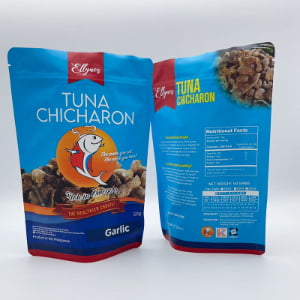
A stand-up pouch includes a bottom gusset.
When filled, the gusset expands and creates a base that lets the pouch stand upright.
I often use stand-up pouches for:
- Snacks
- Nuts
- Coffee
- Granola
- Dried fruit
- Pet treats
- Protein powder
- Supplements
- Candy
- Sauces
The top can be heat sealed after filling.
I can also add a zipper below the final heat-sealed area. Consumers tear off the top section during first opening and then use the zipper for repeated closing.
This distinction matters.
The zipper is usually a reclosure feature, while the original heat seal provides the unopened package's primary closure.
Commercial pouch systems can also use easy-open features, reclosable zippers, fitments, caps, and custom gusset configurations.
Flat Bottom Bags
A flat bottom bag has a defined rectangular base plus front, back, and side panels.
I often choose this format for coffee, pet food, premium snacks, tea, and larger dry products.
Its wider base helps create a stable, box-like package.
The top is usually sealed by heat after filling, while a zipper may be added for resealing.
For dry food ingredients, some industrial flat-bottom bag systems also use a heat-sealed inner polyethylene liner. Mondi, for example, describes dry-ingredient bags in which the inner film is hermetically heat sealed while the outer paper layers provide additional transport protection.
Side Gusset Bags
Side gusset bags expand at the left and right sides.
I often see them used for:
- Coffee
- Tea
- Flour
- Grains
- Nuts
- Bakery ingredients
- Bulk dry food
Depending on the design, the bag may use a top heat seal, back seal, corner seals, or tin-tie-style reclosure after the primary seal is opened.
Vacuum and Shrink Bags
Vacuum food bags are common for meat, cheese, seafood, and processed foods.
The package is loaded, air is evacuated, and the open end is heat sealed.
Some films are also heat-shrinkable. After vacuum sealing, the package can pass through hot water or another shrinking process so the film contracts tightly around the product.
Sealed Air offers barrier shrink bags designed for high-speed vacuum shrink equipment, with different sealing configurations, barrier levels, gauges, and easy-open options.
Retort Pouches
Retort pouches are designed for shelf-stable foods that undergo high-temperature thermal processing after sealing.
I may use them for:
- Ready meals
- Sauces
- Rice
- Soups
- Wet pet food
- Meal toppers
- Other moist foods
Retort pouches can use 3-side seal or gusseted constructions and may include foil or clear barrier structures.
Their sealing process must be tightly controlled because the pouch needs to remain intact during high-temperature processing and later distribution.
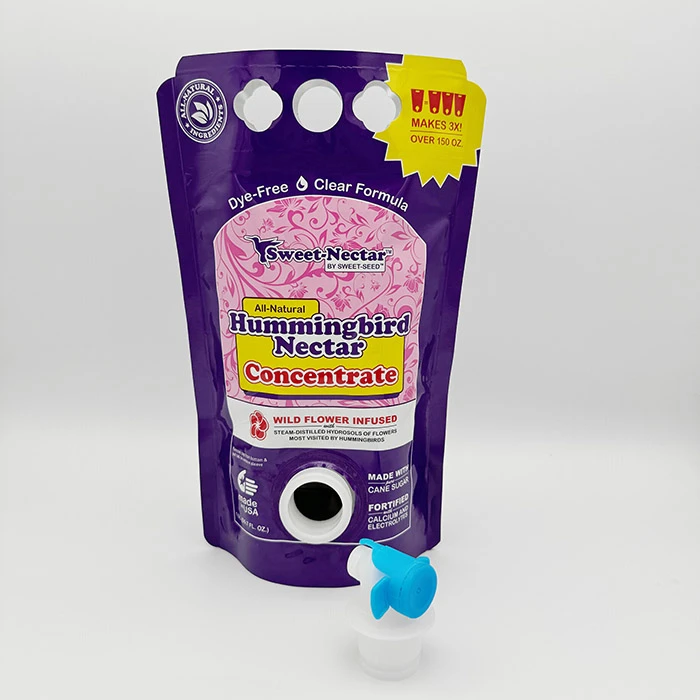
Spout Pouches
Spout pouches are commonly used for liquids and semi-liquids.
Examples include:
- Fruit puree
- Sauce
- Syrup
- Juice
- Baby food
- Condiments
- Liquid ingredients
The pouch film is heat sealed around a molded plastic fitment or spout.
A cap then provides consumer reclosure.
This structure means the pouch uses more than one type of closure: permanent heat seals form the pouch body and attach the fitment, while the cap provides repeated opening and closing.
Form-Fill-Seal Bags
Some food bags are not supplied as premade pouches.
Instead, packaging film enters a machine that forms the bag, fills it, and seals it in one continuous operation.
Vertical form-fill-seal systems can package liquid and pourable foods such as soups, sauces, dressings, condiments, and ground meat. Horizontal form-fill-seal systems are also used for foods such as fresh meat, cheese, and baked goods.
This approach can be highly efficient for large-volume food production.
How Are Food Packaging Bags Sealed?
I see heat sealing as the most important sealing technology in flexible food packaging, but it is not the only method.
Food packaging bags can be sealed with hot-bar heat sealing, impulse sealing, continuous band sealing, vacuum heat sealing, form-fill-seal jaws, zipper systems, spout or fitment sealing, clips, and specialized retort sealing. The correct method depends on the film sealant layer, bag structure, food contamination risk, machine speed, and required package integrity.
Hot-Bar Heat Sealing
Hot-bar sealing is one of the most common methods I use for premade food pouches.
Two heated sealing jaws press the film layers together.
The inner sealant layers soften and bond under a controlled combination of:
- Temperature
- Pressure
- Time
FDA guidance identifies hot-bar sealing as the most widely used heat-sealing method for retort pouches. The heated bars remain at operating temperature throughout production.
I may use hot-bar sealing for:
- Stand-up pouches
- 3-side seal bags
- Flat bottom bags
- Zipper pouches
- Retort pouches
- Powder packaging
- Snack bags
The film structure must have a compatible heat-seal layer.
PE and CPP are common sealant materials in many flexible packaging laminates, although the exact structure depends on the application.
Impulse Sealing
Impulse sealers work differently.
The heating element is powered only during the sealing cycle rather than staying continuously hot.
FDA describes impulse sealing as a process in which the sealing bars press the pouch while an electrical element heats the seal area, after which the same jaws remain closed during cooling.
I often consider impulse sealing for:
- Lower-speed operations
- Manual pouch filling
- Small batches
- Samples
- Trial production
- Certain thicker flexible films
The cooling stage can help the seal set before the jaws open.
Continuous Band Sealing
For higher throughput, I may use a continuous band sealer.
The filled pouch travels along a conveyor while heated bands continuously seal the top.
I often see this method used for:
- Snacks
- Powders
- Dry ingredients
- Coffee
- Nuts
- Granola
- Pet treats
The advantage is production speed.
However, I still need to control temperature and conveyor speed carefully.
If the line moves too quickly, the film may not receive enough heat. If the temperature is too high, the laminate can distort or damage the seal area.
Vacuum Sealing
Vacuum sealing adds another step before heat sealing.
I remove air from around the product and then heat seal the bag.
This is common for:
- Meat
- Cheese
- Seafood
- Processed protein
- Frozen food
- Food-service products
Vacuum shrink packaging may then use heat to shrink the film tightly around the product.
Sealed Air notes that its barrier shrink bags are heat sealable and shrinkable for vacuum packaging and can use side or end seal configurations depending on the product and equipment.
Zipper Closures
A zipper is different from a permanent heat seal.
I normally place the zipper below the top seal.
During production, the pouch is filled and heat sealed above the zipper.
The consumer tears open the top section and then uses the zipper for resealing.
This combination works well for:
- Coffee
- Nuts
- Granola
- Pet treats
- Dried fruit
- Protein powder
- Large snack packs
A zipper improves convenience, but I would not rely on a consumer zipper as the only original closure for many retail food products.
Spout and Fitment Sealing
A spout pouch requires a fitment to be sealed into the pouch.
The sealing jaws must form a reliable bond around the shaped spout base.
This can be more complicated than sealing two flat film surfaces because the material needs to follow the geometry of the fitment.
Once the spout is permanently attached, a screw cap or other closure provides consumer access.
Commercial liquid-food pouch portfolios include spouted, hot-fill, and retort structures for products ranging from juice to soup.
Clip Sealing
Some cylindrical flexible food packages use metal or plastic clips at their ends.
Chub packaging is a good example.
Sealed Air describes chub packaging as tubular flexible film commonly used for ground meat, sausages, or pet food, with the ends traditionally closed using metal or plastic clips.
I see this as a specialized sealing system rather than a typical pouch closure.
Which Sealing Method Fits Each Type of Food Packaging Bag?
I do not believe I can choose a sealing machine correctly without first understanding the package and product.
Premade stand-up, flat bottom, side gusset, and 3-side seal bags normally use heat sealing for their final closure. Vacuum bags combine air evacuation with heat sealing. Retort pouches require validated fusion seals. Spout pouches use heat-sealed fitments plus caps, while chub packaging may use clips. Form-fill-seal bags are formed and sealed directly on automated equipment.
My Practical Bag and Seal Comparison
| Food Packaging Bag | Common Sealing Method | Common Applications |
|---|---|---|
| 3-side seal pouch | Hot-bar, impulse, or band heat seal | Spices, samples, powders, sauces |
| Stand-up pouch | Top heat seal + optional zipper | Snacks, coffee, nuts, pet treats |
| Flat bottom bag | Top heat seal + optional zipper | Coffee, tea, premium dry foods |
| Side gusset bag | Heat seal, back seal, top seal | Coffee, flour, grains |
| Vacuum bag | Vacuum + heat seal | Meat, seafood, cheese |
| Vacuum shrink bag | Vacuum heat seal + shrink | Meat, poultry, cheese |
| Retort pouch | Validated high-integrity heat seal | Meals, sauces, wet pet food |
| Spout pouch | Fitment heat seal + cap | Purees, sauces, liquids |
| Zipper pouch | Permanent heat seal + zipper reclosure | Multi-use dry foods |
| Chub bag | Clip or clipless sealing system | Ground meat, sausage, pet food |
| VFFS bag | Machine heat-sealed seams | Snacks, powders, sauces |
| HFFS pouch | Automated heat seal | Meat, cheese, bakery items |
Dry Foods Are Usually More Forgiving
For dry products such as snacks, coffee, nuts, tea, and powders, I often use conventional heat sealing.
However, powders can still create seal contamination.
Fine particles may fall into the top seal zone.
If I heat seal through powder, I can create small channels or weak points.
This is why clean sealing areas are important even when the food itself is not liquid.
Liquids Require More Attention to Contamination
Sauces, purees, soups, and wet foods can enter the seal area during filling.
FDA specifically identifies food, grease, moisture, wrinkles, and other contamination as factors that can weaken pouch seals.
I therefore consider:
- Fill level
- Headspace
- Product viscosity
- Filling nozzle position
- Splash control
- Sealant material
- Seal temperature
- Seal pressure
- Dwell time
A seal can look closed from the outside and still contain a microscopic leakage path.
Retort Foods Require Much Tighter Control
I treat retort sealing as a separate category because package integrity is essential to the thermal process and shelf-stable product.
FDA identifies three central heat-sealing variables for retort pouches:
- Seal temperature
- Seal pressure
- Dwell time
It also emphasizes that these factors are interdependent.
I therefore do not simply copy sealing settings from another pouch.
A different laminate, thickness, seal width, machine speed, or product can change the optimum conditions.
How Do I Choose the Right Food Bag and Sealing Method?
I think the best sealing system begins with the food itself rather than the packaging machine.
I choose a food packaging bag and sealing method by matching the food's physical properties, shelf-life needs, filling temperature, storage conditions, package size, consumer opening method, barrier requirement, and production speed. I then confirm that the sealant layer and sealing equipment can create a strong, repeatable, uncontaminated seal under real production conditions.
I Start With the Food Type
FDA divides food-contact applications into categories that include aqueous products, acidic foods, fatty foods, dairy products, beverages, bakery products, and dry solids. It also distinguishes conditions such as hot filling, frozen storage, room-temperature storage, and high-temperature sterilization.
This matters because one bag material may work for a room-temperature dry snack but not for a retort sauce.
I first ask:
- Is the product dry, liquid, or semi-liquid?
- Does it contain oil or fat?
- Is it acidic?
- Is it hot filled?
- Is it frozen?
- Does it require pasteurization?
- Does it require retort?
- Does the consumer reheat it in the package?
I Then Define the Protection Requirement
I consider:
- Oxygen barrier
- Moisture barrier
- Light barrier
- Aroma retention
- Grease resistance
- Puncture resistance
- Seal strength
The pouch shape does not determine these properties by itself.
A 3-side seal pouch and a stand-up pouch can use very similar laminates.
The material structure provides much of the protective performance.
I Match the Closure to Consumer Behavior
If the food is single-use, I may only need a tear notch plus permanent heat seal.
If the consumer uses the product repeatedly, I may add a zipper.
If the food is liquid, I may add a spout.
If the product needs vacuum protection, I use a vacuum-compatible bag.
If it needs thermal sterilization, I use a qualified retort pouch and validated sealing process.
I Test Before Mass Production
I do not rely only on appearance.
A good production seal should be checked for integrity.
FDA inspection guidance discusses defects such as channel leaks, non-bonding, fractures, and improper seals caused by food, grease, moisture, or wrinkles.
Depending on the application, I may evaluate:
- Seal strength
- Burst performance
- Leak testing
- Drop resistance
- Vacuum retention
- Compression
- Retort performance
- Filled-package aging
This is especially important when changing film suppliers or production speed.
My Insights: Types of Food Packaging Bags and Their Sealing Methods
I think the most important lesson is that the bag shape and sealing process should be treated as one packaging system.
The main types of food packaging bags include stand-up, flat, 3-side seal, flat bottom, side gusset, vacuum, retort, spout, zipper, shrink, and form-fill-seal bags. Their sealing methods differ because each product creates different pressure, contamination, temperature, handling, and consumer-use requirements. I choose the seal by function rather than by bag name alone.
I Think Seal Design Is More Important Than Many Buyers Expect
A beautiful printed pouch can still fail at the seal.
If the seal leaks, the package can lose barrier performance even when the film itself has excellent oxygen and moisture resistance.
This means I do not see sealing as the final minor stage of pouch production.
I see it as part of the barrier system.
A high-barrier laminate only works when the package remains closed.
I Separate Permanent Sealing From Consumer Reclosure
This is another important distinction.
A zipper is not the same as the original heat seal.
A cap is not the same as the spout-to-film seal.
The consumer closure supports repeated use.
The manufacturing seal establishes the original package integrity.
I often explain it this way:
| Closure Function | Example |
|---|---|
| Permanent production seal | Heat-sealed pouch top |
| Consumer reclosure | Zipper |
| Permanent fitment attachment | Heat-sealed spout base |
| Consumer liquid closure | Screw cap |
| Vacuum package closure | Heat seal after air removal |
| Chub closure | Clip or machine seal |
This distinction helps me avoid adding the wrong closure technology to a food project.
I Think Product Contamination Is One of the Biggest Real-World Seal Risks
When a production line runs quickly, a small amount of powder, oil, sauce, or moisture can enter the seal zone.
The machine may still close the jaws.
The seal may still look acceptable.
However, the contaminated area can become a weak path.
FDA guidance repeatedly emphasizes keeping sealing surfaces smooth, parallel, wrinkle-free, and free from food, grease, moisture, and other contaminants.
For me, this is why better filling control can sometimes improve seal reliability more than simply increasing seal temperature.
I Would Not Increase Heat Without Understanding the Problem
When a seal is weak, increasing temperature may look like an easy solution.
I do not automatically do that.
Too much heat can damage the film, distort the pouch, or reduce seal quality.
The correct balance involves:
- Temperature
- Pressure
- Dwell time
- Film structure
- Sealant layer
- Machine speed
- Seal contamination
For retort pouches in particular, FDA treats temperature, pressure, and dwell time as interdependent critical factors.
My Practical Selection Framework
| If I Am Packaging... | Bag I Often Consider | Sealing Direction |
|---|---|---|
| Snack | Stand-up or flat pouch | Heat seal + optional zipper |
| Coffee | Stand-up, flat bottom, side gusset | Heat seal + zipper/valve as needed |
| Spice | 3-side seal pouch | Heat seal |
| Powder | Flat or stand-up pouch | Heat seal with clean seal zone |
| Meat | Vacuum/shrink bag | Vacuum + heat seal |
| Cheese | Vacuum or barrier pouch | Vacuum/heat seal |
| Sauce | 3-side seal or spout pouch | Heat seal or spout fitment seal |
| Baby puree | Spout pouch | Fitment heat seal + cap |
| Ready meal | Retort pouch | Validated fusion heat seal |
| Wet pet food | Retort pouch | Retort-qualified heat seal |
| Ground meat | Chub packaging | Clip or clipless system |
| High-volume snacks | VFFS bag | Automated heat seal |
I therefore do not ask only, “What type of food bag should I buy?”
I ask:
How will the food be filled?
What can damage it?
What temperature will the package experience?
How long does it need to stay protected?
How will the consumer open and close it?
What seal can the production line make consistently?
Once I answer those questions, the correct bag and sealing method become much easier to specify.
Conclusion
I match food packaging bags with sealing methods based on product type, barrier needs, filling conditions, consumer use, and production equipment. A reliable seal is essential because even the best packaging film cannot protect food if the closure fails.