
](https://www.sglpackaging.com/wp-content/uploads/2026/08/What-is-the-Difference-Between-a-Flat-Bottom-Pouch-Stand-Up-Pouch.webp "What is the Difference Between a Flat Bottom Pouch & Stand Up Pouch? 1")
I often see buyers compare flat bottom pouches and stand up pouches because both stand on shelves, but their construction and real packaging performance are quite different.
I see the main difference in the bottom and side structure. A stand up pouch uses an expandable bottom gusset to stand after filling. A flat bottom pouch uses a defined flat base plus side gussets, which creates a more box-like shape, greater shelf stability, and additional printable panels.
I do not choose between these two pouch types only by appearance. I look at product weight, density, filling volume, shelf presentation, printing area, packaging equipment, material structure, shipping efficiency, and total cost. When I compare all of these points together, the better pouch format usually becomes much clearer.
What Is a Flat Bottom Pouch?
I often describe a flat bottom pouch as a flexible package that combines some of the visual structure of a box with the lightweight benefits of flexible packaging.
I define a flat bottom pouch as a flexible bag with a rectangular flat base, front and back panels, and two side gussets. These sections create a structured, box-like shape when the pouch is filled. I commonly see this format used for coffee, tea, snacks, pet food, supplements, and premium dry products.
How I Look at the Flat Bottom Structure
I first look at the number of functional surfaces.
A typical flat bottom pouch gives me a front panel, back panel, two side gussets, and a bottom panel. This construction gives the package a wider and more defined base than a standard stand up pouch. The structure also creates several areas that a brand can use for printing.
I find this useful when a package needs more than a large logo on the front.
For example, I can use the front for the main brand identity. I can use the back for ingredients, instructions, and regulatory information. I can use one side gusset for flavor information and another side for a product story, barcode, QR code, or brewing instructions.
That extra surface area can matter in categories such as coffee and specialty food.
| Feature | Flat Bottom Pouch |
|---|---|
| Bottom | Defined rectangular base |
| Side structure | Two side gussets |
| Filled shape | Box-like and structured |
| Shelf stability | Usually very strong |
| Printable areas | Front, back, sides, and often bottom |
| Common applications | Coffee, tea, pet food, snacks, powders |
| Typical positioning | Premium and retail-focused |
I also pay attention to terminology. Some suppliers use terms such as box pouch, box bottom pouch, block bottom pouch, or flat bottom bag for related formats. I do not rely on the product name alone because pouch terminology is not always consistent between manufacturers. I prefer to confirm the actual drawing, bottom construction, seal position, and side gusset design before production.
Why I Consider It for Premium Products
I usually consider a flat bottom pouch when a brand wants a clean and structured shelf presentation.
The wide base helps the filled bag stay upright. The straight side panels can also make several packages look more organized when they stand next to each other.
I find this especially useful for products such as roasted coffee, premium snacks, granola, nutritional powders, and pet treats. These products often need both functional packaging and strong shelf presentation.
However, I do not assume that the flat bottom shape automatically provides better freshness. I still need to select the correct flexible packaging material according to oxygen, moisture, light, aroma, grease, and puncture requirements.
The shape and the barrier structure solve different problems.
What Is a Stand Up Pouch?
I see stand up pouches as one of the most versatile flexible packaging formats because their simple structure works with many products and optional features.
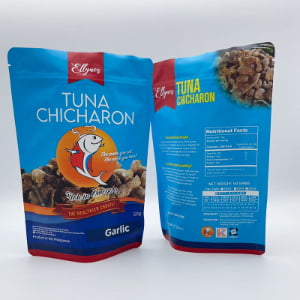
I define a stand up pouch as a flexible pouch with a bottom gusset that expands when the product is filled into the package. The opened gusset creates a base that allows the pouch to stand upright. I commonly use this format for snacks, powders, dried fruit, supplements, pet treats, sauces, and household products.
How the Bottom Gusset Works
I think the bottom gusset is the easiest way to understand the difference.
A standard stand up pouch normally has large front and back panels and a folded bottom section. When the pouch is empty, the bottom gusset stays folded inside. When the product enters the pouch, the gusset opens and creates space.
The weight and volume of the product help form the final standing shape.
This construction makes the pouch flexible. It can adapt to different products without requiring the same box-like geometry as a flat bottom pouch.
I often consider that flexibility useful for brands with several product sizes or many SKUs.
| Feature | Stand Up Pouch |
|---|---|
| Bottom | Expandable bottom gusset |
| Side gussets | Usually not required |
| Filled shape | Flexible and often rounded at the base |
| Shelf stability | Good when correctly sized and filled |
| Main printing areas | Large front and back panels |
| Common applications | Snacks, powders, supplements, sauces, pet treats |
| Typical positioning | Versatile and cost-efficient |
Stand up pouches can also accept many functional features.
I can add a resealable zipper for products that consumers open several times. I can add a tear notch for easier opening. I can consider a hang hole for retail display. I can use a transparent window when the brand wants consumers to see the product.
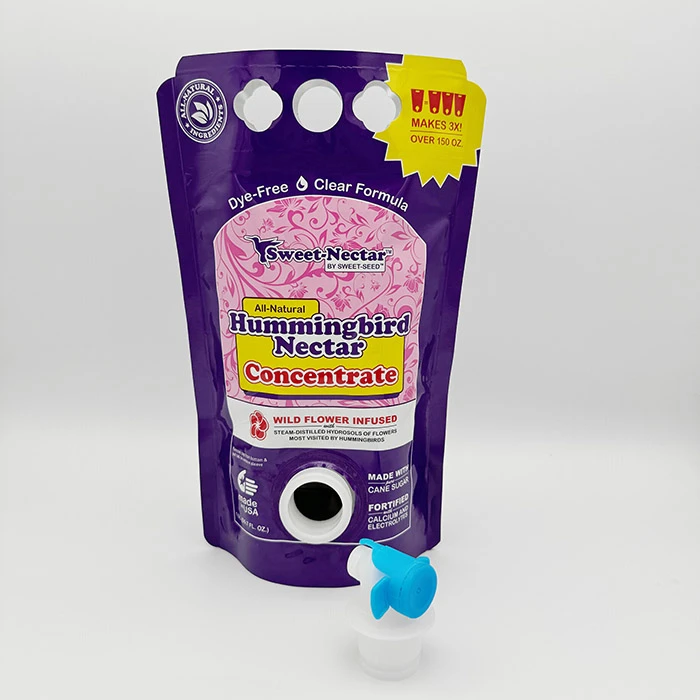
For coffee packaging, I can also consider a one-way degassing valve when the product requires it. For liquid applications, I can evaluate a spout structure rather than a standard zipper.
Why I Often See Lower Packaging Complexity
I generally find a standard stand up pouch simpler than a flat bottom pouch because it does not need the same multi-panel box construction.
That simpler pouch construction can reduce converting complexity and, depending on dimensions, materials, quantity, printing method, and features, can make the stand up pouch a more cost-efficient option. Current packaging comparisons generally position stand up pouches as the simpler and lower-cost choice, while flat bottom pouches tend to use a more complex construction.
I still avoid comparing price only by pouch style.
A small high-barrier stand up pouch with a premium zipper and special finishing can cost more than a simple flat bottom pouch in another specification. Material thickness, laminate structure, order quantity, printing colors, zipper type, finishing, size, and production process can all change the final price.
I therefore compare quotations only after the specifications are aligned.
Which Pouch Has Better Shelf Stability?
I consider shelf stability one of the clearest differences because the two packages create their standing bases in different ways.
I generally expect a flat bottom pouch to provide stronger and more consistent shelf stability because it has a broad, defined base and a more structured shape. A stand up pouch also stands well, but its performance depends more heavily on bottom-gusset expansion, product weight, product distribution, pouch dimensions, and fill level.
Why Product Density Changes the Result
I never judge shelf stability from an empty sample.
The actual product can completely change how a pouch performs.
For example, I can place 250 grams of coffee beans and 250 grams of dense powder into two pouches with similar external dimensions. The products have the same weight, but they do not occupy the same volume or distribute their weight in the same way.
The pouch dimensions must match the actual product.
A stand up pouch can stand very well when its bottom gusset opens correctly and the product fills the lower section evenly. However, an oversized pouch with too little product may look soft or may not present its front panel well.
A flat bottom pouch has a more defined base, but I still need the correct fill volume. An underfilled flat bottom bag can lose some of the clean box-like appearance that the buyer expected. An overfilled package can place unnecessary pressure on seals and closing areas.
I Compare Stability in Real Conditions
I prefer to test several factors before approving production:
- I check whether the pouch stands after filling.
- I check whether it stays upright after product settling.
- I check whether the front panel remains presentable.
- I check how several pouches sit next to one another.
- I check how the pouch fits inside shipping cartons.
- I check whether vibration during transportation changes its shape.
- I check whether the zipper and top seal remain easy to use.
I also think about the sales channel.
A package sold mainly on a supermarket shelf may benefit greatly from strong standing stability. A product sold mostly through e-commerce may place more importance on shipping efficiency, puncture resistance, and protection inside a carton.
This is why I do not automatically pay more for a flat bottom structure. I choose it when its stability and presentation create a real benefit for the product.
Which Is Better for Coffee, Snacks, and Pet Food?
I regularly see both pouch formats in coffee, snack, and pet food packaging, so I do not believe the product category alone can decide the structure.
I usually consider flat bottom pouches for premium coffee, specialty foods, heavier dry products, and products that need strong shelf presence. I often consider stand up pouches for snacks, powders, supplements, smaller pet treats, and brands that prioritize versatility and cost control. Both formats can use high-barrier materials and resealable features.
Coffee Packaging
I see flat bottom coffee bags frequently because the box-like shape works well with premium coffee branding.
The side gussets give me additional areas for information about roast level, origin, tasting notes, brewing method, or brand story. The broad bottom also gives the package a strong retail stance.
However, I do not think every coffee brand needs a flat bottom pouch.
A stand up coffee pouch can still look professional. It can support a zipper, high-barrier laminate, and degassing valve. It may also make sense when a brand has many blends and wants to control packaging costs.
The freshness requirement comes from the material and closure system more than the external shape.
Snack Packaging
I often start with a stand up pouch for snacks because the structure is flexible and familiar.
Products such as nuts, dried fruit, candy, granola, chips, and small snack portions can work well in a stand up zipper pouch.
I may move toward a flat bottom pouch when the product is positioned as premium or when the brand needs stronger shelf blocking.
Pet Food and Pet Treat Packaging
I consider both formats for pet products.
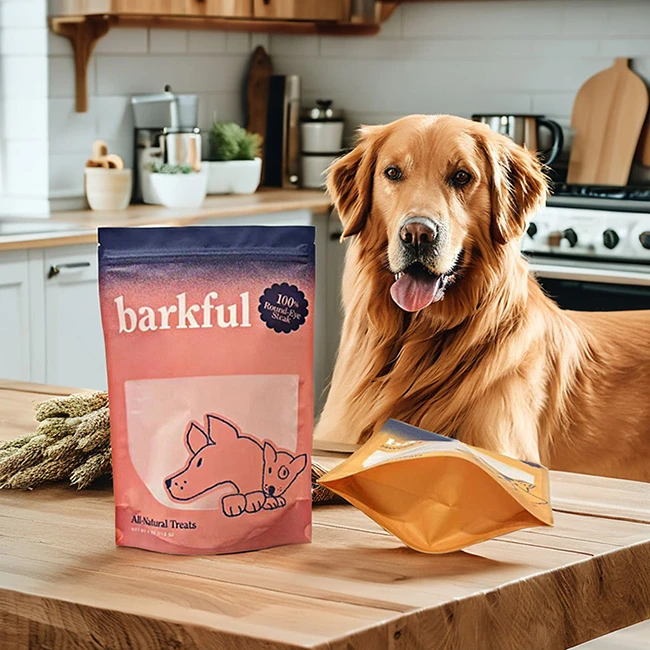
A smaller package of pet treats may work very well in a stand up pouch. A larger or heavier dry product may benefit from the more structured shape of a flat bottom pouch.
I compare the formats this way:
| Decision Factor | Stand Up Pouch | Flat Bottom Pouch |
|---|---|---|
| Lightweight snacks | Very suitable | Suitable |
| Premium coffee | Suitable | Very suitable |
| Small pet treats | Very suitable | Suitable |
| Heavier dry products | Suitable with correct design | Often very suitable |
| Premium shelf image | Good | Strong |
| Multiple printable side panels | Limited | Strong advantage |
| Cost control | Often stronger | Usually higher cost |
| Structural appearance | Flexible | Box-like |
| Zipper option | Available | Available |
| High-barrier materials | Available | Available |
| Degassing valve | Available | Available |
The table helps me narrow down the options, but I still test the actual product before deciding.
Are Flat Bottom Pouches More Expensive Than Stand Up Pouches?
I often receive this question because the visible difference between the two pouch types does not always look large enough to explain the price difference.
I generally expect flat bottom pouches to cost more than comparable stand up pouches because their construction uses more panels, gussets, seals, and converting steps. However, I calculate cost using the complete specification because material structure, pouch dimensions, printing, quantity, zipper, valve, finishing, and manufacturing method can matter more than shape alone.
I Look Beyond Unit Price
I do not think the lowest pouch price always creates the lowest packaging cost.
A packaging buyer also needs to consider filling speed, rejects, storage space, carton dimensions, transport efficiency, shelf performance, and consumer experience.
For example, a flat bottom pouch may cost more per piece but can provide a stronger premium presentation. If that appearance supports a higher retail price or improves the way the product is displayed, the additional packaging cost may make commercial sense.
On the other hand, a stand up pouch may already provide enough stability and branding space for the product. In that case, paying for a more complex structure may not provide a useful return.
What I Include in a Real Cost Comparison
I normally compare:
| Cost Area | What I Check |
|---|---|
| Film | Material type, laminate and thickness |
| Printing | Printing method, colors and artwork complexity |
| Pouch converting | Structure and manufacturing difficulty |
| Closures | Standard zipper, pocket zipper, valve or spout |
| Finishing | Matte, glossy, spot effects or special surface treatment |
| Order quantity | MOQ and unit volume |
| Filling | Manual or automatic packing requirements |
| Logistics | Empty pouch storage and filled carton efficiency |
| Retail value | Shelf presentation and branding impact |
This broader calculation gives me a more useful answer than simply asking which pouch is cheaper.
My Insights: What is the Difference Between a Flat Bottom Pouch & Stand Up Pouch
I think the most useful comparison goes beyond the obvious fact that one pouch has a flat rectangular bottom and the other uses an expandable gusset.
I see the real difference between a flat bottom pouch and a stand up pouch as a balance between structural control and packaging flexibility. A flat bottom pouch creates a more defined package with greater panel space and shelf stability. A stand up pouch uses a simpler structure that usually provides more flexibility and cost efficiency.
I Would Not Choose the Pouch Before Knowing the Product
This is the most important rule I use.
I do not select the package only from an image, catalog, or standard size chart.
I first need to know the product weight and product volume. I also need to understand product density. I want to know whether the product contains powder, sharp edges, oil, moisture, or strong aroma. I need to know whether the consumer will open the package once or many times.
After that, I can consider the pouch shape.
A flat bottom pouch can look better in a product rendering, but that does not guarantee that it will perform better after filling. A stand up pouch can look simpler in a drawing, but it may provide exactly the right combination of usability, cost, and shelf performance.
The Shape Does Not Decide the Barrier
I also separate pouch structure from material structure.
Both flat bottom pouches and stand up pouches can use laminated flexible packaging films. Both formats can use materials designed to resist oxygen, moisture, light, grease, or aroma loss.
For this reason, I would never say that flat bottom packaging automatically keeps a product fresher than stand up packaging.
I ask a different question:
What barrier does the actual product need?
I then select the film structure around that requirement.
I Compare Branding Space Differently
A stand up pouch gives me a strong front-facing branding area. This is enough for many products.
A flat bottom pouch gives me more defined surfaces. The side gussets can become real communication panels instead of simply folded areas.
That can change the branding strategy.
For a premium coffee bag, I may put the logo and coffee name on the front. I may put preparation information on the back. I may use one side for origin and tasting notes. I may use the other side for the brand story.
I can create a more box-like information hierarchy without moving to rigid packaging.
My Practical Decision Framework
When I compare the two formats, I usually think about them like this:
| If I Need... | I Usually Consider... |
|---|---|
| Lower structural complexity | Stand up pouch |
| Flexible sizing across many SKUs | Stand up pouch |
| Cost-efficient retail packaging | Stand up pouch |
| A simple large front graphic | Stand up pouch |
| Stronger box-like appearance | Flat bottom pouch |
| Greater filled stability | Flat bottom pouch |
| More defined side printing areas | Flat bottom pouch |
| Premium coffee presentation | Flat bottom pouch |
| Strong shelf blocking | Flat bottom pouch |
| Maximum flexibility for product categories | Stand up pouch |
I still treat this table as a starting point rather than a final specification.
I always think about the full packaging system. The pouch structure, flexible packaging material, zipper, sealant layer, printing, filling method, finished dimensions, and shipping carton all work together.
That is why I do not ask only, “Which pouch looks better?”
I ask which pouch performs better for this product, on this filling line, in this sales channel, at this target cost.
Once I answer those questions, the difference between a flat bottom pouch and a stand up pouch becomes much more useful than a simple comparison of their shapes.
Conclusion
I choose flat bottom pouches for stronger structure, stability, and premium presentation, while I choose stand up pouches when flexibility, versatility, and cost efficiency matter more.