
1.19 billion by 2035 — that is where the global coffee packaging market is headed, growing at 5.6% a year. To put that in perspective, we are talking about a market roughly the size of Iceland's entire GDP, dedicated entirely to keeping coffee fresh. Yet for specialty roasters and brand founders, finding a coffee packaging manufacturer worth their salt remains one of the most stubborn procurement headaches out there. You need bags that lock in aroma for weeks, survive international shipping, look good on a shelf, and meet sustainability rules that get tighter every year — all without eating your margins alive.
Maybe you are sourcing your first 500-bag run. Maybe you are scaling to 50,000 units across a dozen SKUs. Either way, the manufacturer you pick touches nearly every part of your business: product quality, brand perception, regulatory compliance. This guide walks through what actually matters when choosing a partner — material barrier technology, customization depth, certification requirements, and the practical steps for building a supplier relationship that lasts, especially at small batch volumes.
Why Your Coffee Packaging Manufacturer Choice Matters More Than You Think
Freshly roasted coffee starts losing peak flavor within 2-3 weeks. That is not opinion — it is chemistry. The packaging stands as your single most important defense against oxygen, moisture, UV light, and temperature swings that speed up staleness. A good coffee packaging manufacturer does not just slap your logo on a bag. They engineer a multi-layer barrier system calibrated to your roast profile and shelf-life needs.
Look at the economics. Packaging typically runs 3-8% of a specialty coffee product's retail price — roughly what you would spend on labels and shipping combined. But a substandard bag that lets oxygen creep in? That can ruin an entire batch, turning a 15 retail bag into a 0 write-off. The real cost of bad packaging is not the bag itself. It is the lost trust, the one-star reviews, the damaged brand equity that follows.
For roasters shipping to both US and EU markets, the stakes climb even higher. The EU PPWR, effective 2030, mandates recyclable packaging across the board. Several US states have rolled out EPR laws that make brands financially responsible for packaging waste. Your manufacturer needs to understand these regulations and offer compliant solutions — not just today, but proactively as the rules keep shifting.
Coffee Packaging Bag Types: Understanding Materials and Barrier Technology
The Science of Freshness: OTR, WVTR, and Degassing Valves
Three technical metrics determine how well a coffee bag protects what is inside:
- Oxygen Transmission Rate (OTR): How much oxygen seeps through the bag material per day. For whole bean coffee, aim for OTR below 1 cc/m²/day — think of it as a force field rated by how little oxygen gets through. Premium foil laminates hit 0.1-0.5. That is essentially airtight.
- Water Vapor Transmission Rate (WVTR): The moisture barrier metric. Below 5 g/m²/day works for most climates.
- Coffee bag degassing valve: Freshly roasted beans off-gas CO₂ for days after roasting. A one-way valve vents that gas without letting oxygen back in — preventing bag explosions and preserving flavor. Here is the thing: valve brand actually matters. Wipf (Swiss) and Goglio (Italian) are the gold standards in this space, outperforming generic alternatives in both flow rate and seal reliability.
Material Comparison: Four Main Options
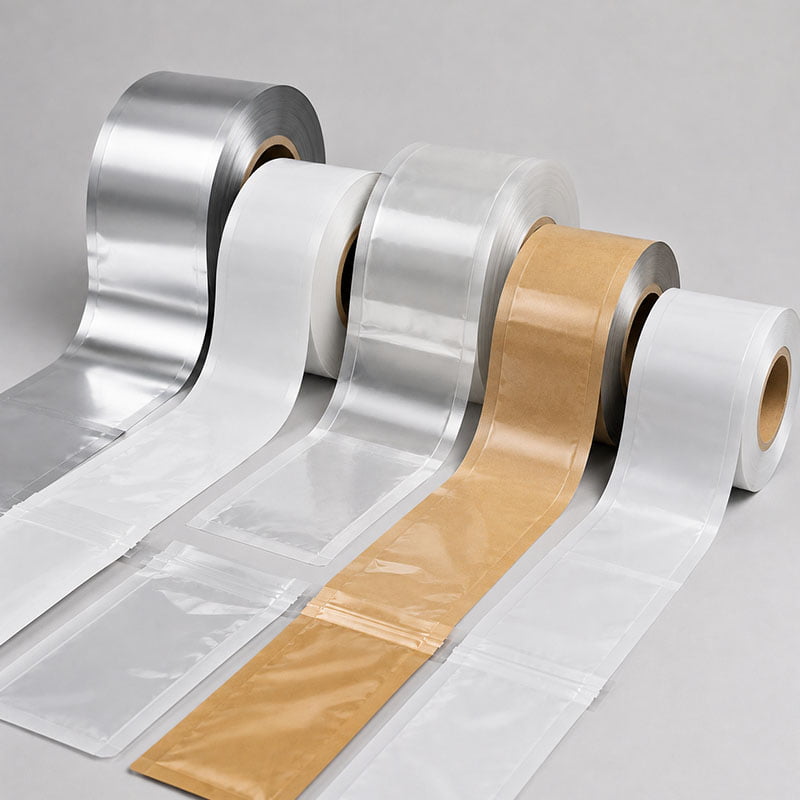
When you evaluate coffee packaging bag types, four primary material structures will come up. Each carries distinct trade-offs in barrier performance, cost, and sustainability.
| Material | OTR (cc/m²/day) | Shelf Life | Cost/pc | Sustainability |
| Aluminum Foil Laminate (PET/AL/PE) | < 0.5 | 12+ months | $0.08–0.25 | Low (not recyclable) |
| Metallized Film (PET/VMPET/PE) | 1–5 | 6–12 months | $0.05–0.15 | Medium |
| Kraft Paper + Inner Liner | Varies by liner | 3–6 months | $0.04–0.12 | Medium (FSC certified) |
| Compostable PLA/PBAT | 5–15 | 3–6 months | $0.12–0.30 | High (industrial composting) |
Aluminum foil laminates deliver the best barrier protection — period. They are the default choice for premium whole bean coffee. But here is the catch: they are not recyclable in most municipal systems. Metallized films offer a middle ground. Good barrier, lower cost. Recycling remains tough, though, because of the multi-layer construction.
Kraft paper bags with inner liners give you that eco-friendly aesthetic specialty consumers love. The natural, artisanal look plays well for wholesale and subscription models. But barrier performance depends entirely on the liner — so always request OTR data for the complete structure, not just the outer layer. We have seen too many roasters get burned by assuming kraft alone means good protection.
Compostable coffee packaging using PLA/PBAT films is the fastest-growing segment right now. These materials break down in industrial composting facilities within 90-180 days — compared to the 400+ years a conventional plastic bag takes to decompose. That said, barrier properties run lower than traditional materials, and shelf life may be shorter. A critical consideration if you are distributing internationally.
How to Evaluate a Coffee Packaging Supplier: Certifications and Compliance
Essential Certifications to Verify
When you vet a coffee packaging supplier, certifications are your first line of due diligence. They provide third-party validation that the manufacturer meets international food safety and quality standards. Not just marketing claims — actual audited compliance.
BRCGS (Brand Reputation through Compliance Global Standards): The most widely recognized packaging certification in food. BRCGS audits cover food safety management, hazard analysis, and product quality. If your coffee lands on major retail shelves in the US or EU, BRCGS is often non-negotiable.
SQF (Safe Quality Food): Big in North America. SQF certification shows that the manufacturer follows rigorous food safety protocols from raw material sourcing through production and distribution.
ISO 22000: An international food safety management standard that pairs well with BRCGS and SQF. Some manufacturers hold both for broader market coverage.
FDA 21 CFR (US Market): Materials must comply with FDA Title 21 Code of Federal Regulations for indirect food contact. Request a Declaration of Compliance (DoC) document — in writing, not over the phone.
EU 1935/2004 (European Market): The framework regulation for food contact materials in the EU. Compliance documentation, including migration test results, must be provided by the manufacturer.
FSC (Forest Stewardship Council): Using kraft paper? FSC certification makes sure the paper comes from responsibly managed forests. Increasingly expected by eco-conscious consumers, and frankly, required by some retailers.
Red Flags to Watch For
- Audit certificates older than 12 months
- No documented traceability system for raw materials
- Reluctance to share OTR/WVTR test data
- Vague "food-grade" claims without specific regulatory references
- Zero experience exporting to your target markets
If a supplier ticks any of these boxes, walk away. Trust your gut on this one.
Custom Coffee Packaging Bags: Branding, Design, and Customization
Think about the last time you picked up a coffee bag in a store. What made you reach for it? Custom coffee packaging bags let you turn a functional container into your best salesperson on the shelf.
Printing Technologies
Three primary printing methods are used by coffee bag manufacturers:
Rotogravure printing delivers the highest quality and consistency for large runs. Up to 10 colors, precise matching. The catch? Cylinder costs run $150-400 per color, making it economical only at 5,000+ pieces.
Flexographic printing offers a cost-effective middle ground. Quality is decent but not as sharp as gravure. Best for simpler designs with fewer colors.
Digital printing has changed the game for small-batch roasters. No plates, no cylinders — custom printed coffee bags from as few as 100 pieces. This is huge for micro-roasters testing new blends or seasonal drops. The trade-off? Slightly lower color vibrancy and durability compared to gravure.
Bag Configurations
The structure you pick affects both shelf presence and production efficiency:
- Flat bottom bags (eight-side seal): Premium look, five printable sides, excellent shelf stability. Higher cost per unit.
- Stand-up pouches: Versatile and economical. Good for 8oz-12oz retail sizes.
- Side gusseted bags: Classic brick shape. Cost-effective for wholesale and 1lb-5lb sizes.
Finishes and Features
Ask your manufacturer about matte or soft-touch coatings for a premium tactile feel, metallic foil stamping for accent elements, EZ-pull zippers for consumer convenience, and transparent windows to showcase the beans. Each feature adds cost — but can set your brand apart on a crowded shelf.
Sustainable Coffee Packaging: PCR, Compostable, and the Future
Sustainability is not a nice-to-have anymore. It is table stakes. Sixty percent of specialty coffee consumers actively seek brands with eco-friendly packaging — up from roughly 35% just three years ago. And regulators are closing in fast.
Post-Consumer Recycled (PCR) Content
PCR coffee bags use recycled plastic content, cutting down on virgin material. Typical PCR content runs 30% to 80%. The challenge: each recycled layer can slightly reduce barrier performance, so compensating layers must be engineered by the manufacturer. Always verify PCR claims are backed by certification (UL 2809 or SCS Global Services). Arguably, this is the most misunderstood sustainability claim in the industry right now.
Home Compostable Coffee Packaging
The frontier. Unlike industrial compostable materials that need 55-70°C facility temperatures, home compostable coffee packaging breaks down at ambient temperatures within 12-24 months. Certifications like OK Compost HOME (TÜV Austria) back up the claims. Limited suppliers so far, but demand is climbing fast. In our view, this category will explode once more manufacturers get certified.
Navigating the Compostable vs. Biodegradable Confusion
Here is the deal: many manufacturers throw around "biodegradable" and "compostable" like they mean the same thing. They do not. Biodegradable just means the material will eventually break down — no timeframe, no conditions specified. Compostable means it breaks down into non-toxic components within a specific timeframe under defined conditions. Look for certification marks (BPI, OK Compost), not marketing copy.
Small Batch Coffee Packaging: MOQ, Sampling, and Building Supplier Relationships
Understanding MOQ Tiers
MOQ — the three letters that strike fear into every micro-roaster's heart. Here is what to expect:
| MOQ Range | Printing Method | Best For | Typical Lead Time |
| 100–500 pcs | Digital print | Micro-roasters, sample runs | 7–10 days |
| 1,000–5,000 pcs | Flexo or digital | Small brands, seasonal SKUs | 15–20 days |
| 5,000–10,000 pcs | Rotogravure | Established brands | 15–25 days |
| 10,000+ pcs | Rotogravure | Large-scale production | 20–30 days |
For roasters needing coffee bag MOQ low minimum options, digital printing is the answer. Some suppliers — MTPak Coffee, GSL Pack — now offer digital print from 100 pieces. That means you can test a design before betting the farm on a full gravure run.
The Sampling Process
Never place a bulk order without physical samples. Boots on the ground, this is non-negotiable. The process usually goes like this:
- Request material samples to check barrier properties and tactile feel
- Review printed proofs (digital or physical) for color accuracy
- Run a small production batch (50-100 pieces) on your filling equipment
- Verify valve placement, zipper function, and seal integrity
- Only then commit to bulk
A reliable manufacturer walks you through this without pressure. If a supplier pushes to skip sampling, that is a red flag — plain and simple.
Building a Long-Term Partnership
The best coffee bag manufacturers act like part of your own crew, not just a vendor on a purchase order. Look for partners who proactively suggest material improvements, keep you posted on regulatory changes, offer inventory holding for repeat orders, and maintain consistent quality batch after batch. The goal is not a transactional supplier relationship. It is a collaborative partnership that grows with your brand.
FAQ
What certifications should a coffee packaging manufacturer have?
A reputable coffee packaging manufacturer should hold BRCGS or SQF for food safety, ISO 9001 for quality management, and comply with FDA 21 CFR (US) or EU 1935/2004 (Europe) for food contact materials. For kraft paper, FSC certification is essential. For compostable claims, look for BPI or OK Compost certification — not just the word "compostable" on a spec sheet.
What is the minimum order quantity for custom coffee bags?
MOQ depends on the printing method. Digital printing enables orders from 100-500 pieces — perfect for micro-roasters. Flexographic printing typically needs 1,000-5,000 pieces. Rotogravure, the highest quality option, usually requires 5,000-10,000+ pieces due to cylinder setup costs. Some manufacturers offer coffee bag MOQ low minimum options through digital print.
Are compostable coffee bags as effective as foil bags?
Compostable coffee packaging using PLA/PBAT films provides decent barrier properties (OTR 5-15 cc/m²/day) but generally offers shorter shelf life (3-6 months) compared to aluminum foil laminates (12+ months). For high-turnover specialty coffee, compostable bags work well. For international distribution or long shelf life, foil is still the better barrier choice.
How do I verify a manufacturer's sustainability claims?
Request third-party certification documents — not marketing materials. For compostable claims, look for BPI (US) or OK Compost (EU) certifications. For recycled content, request UL 2809 or SCS validation. For responsibly sourced paper, verify FSC chain-of-custody certificates. A trustworthy supplier hands these over readily.
What is a degassing valve and why does brand matter?
A coffee bag degassing valve is a one-way valve that lets CO₂ escape from freshly roasted beans without letting oxygen in. Valve quality directly impacts freshness. Wipf (Switzerland) and Goglio (Italy) are the industry-standard premium brands — superior flow rates, better seal reliability, and proven track records compared to generic alternatives.
Conclusion
Bottom line: the coffee packaging manufacturer you choose touches nearly every part of your business. Shelf life, brand perception, regulatory compliance, environmental impact — all tied to this one decision. Three things to remember: prioritize barrier performance (OTR, WVTR, valve quality) before aesthetics, verify certifications through documentation not claims, and use digital printing for small batch flexibility.
The packaging landscape is shifting fast, with sustainability rules tightening and consumer expectations climbing. Brands that put in the work to find the right manufacturing partner today will be the ones positioned to adapt tomorrow. Start by requesting samples from 3-5 manufacturers. Compare their technical data side by side. Pick the partner that lines up with your quality standards, volume needs, and sustainability goals. Your coffee deserves nothing less.